

Single Visit TB Blood Test Beats Skin Test for I-693 Applicants

For most people aged 5 and older, especially anyone vaccinated with BCG; doctors and public health agencies now generally favor the TB blood test (IGRA) over the traditional skin test. It requires a single visit and is generally not affected by prior BCG vaccination, unlike the skin test. That said, neither test can tell you whether you have latent infection or active disease. Any positive result, from either test, needs follow-up evaluation.
TL;DR:
- The TB blood test (IGRA) is generally preferred over the skin test for those aged 5 and older, especially with prior BCG vaccination, due to its single visit requirement and reduced false positives.
- Both tests have comparable accuracy, but IGRA’s performance depends on timely lab processing, while the skin test’s reliability hinges on proper timing and measurement.
- False negatives can occur with both tests in immunosuppressed individuals or active TB cases, making follow-up evaluations crucial after any positive result.
- Cost, logistics, and patient circumstances, such as the ability to return for a skin test reading or lab access, should guide the choice between TST and IGRA.
- For immigration purposes, IGRA minimizes delays related to BCG vaccination and repeat testing, streamlining the process for applicants.
Table of Contents
- TB Blood Test vs Skin Test: The Quick Comparison
- How Each TB Test Actually Works
- What the Research Says About Accuracy
- Who Should Get Which Test?
- What a Positive or Negative Result Actually Means
- Getting the Logistics Right
- TB Testing and Your Immigration Medical Exam
- Why the Standard Advice Undersells One Point
- Sources
- FAQ
TB Blood Test vs Skin Test: The Quick Comparison
The tuberculin skin test (TST) and the interferon-gamma release assay (IGRA, sold as QuantiFERON-TB Gold Plus or T-SPOT.TB) both screen for the same thing: whether your immune system has ever encountered TB bacteria. How they get there, and what tangles they leave behind, differs a lot.
- Visits required: IGRA needs one blood draw. TST needs a return visit 48 to 72 hours later so a trained reader can measure the skin reaction, and missing that window means starting over.
- BCG interference: TST can produce a false positive in someone vaccinated with BCG as a child. IGRA generally isn’t affected by prior BCG vaccination.
- Objectivity: IGRA results come from a lab instrument reading a chemical reaction. TST results depend on a person’s hands measuring a bump on skin, which introduces reader variability.
- Turnaround and cost: TST is cheaper per test but requires two appointments. IGRA generally costs more per test but eliminates the need for a return visit.
- Special populations: TST remains standard for children under 5. For individuals aged 5 and older, especially those vaccinated with BCG, IGRA is generally preferred.
How Each TB Test Actually Works
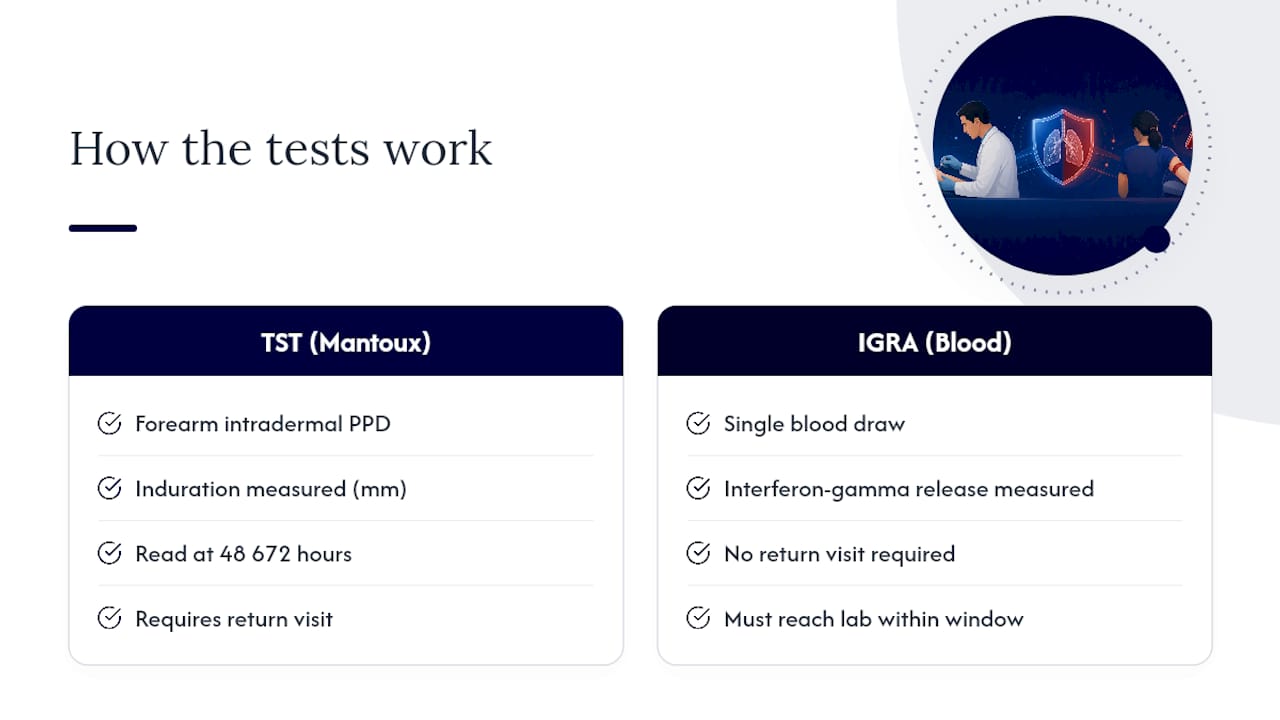
The Mantoux skin test injects a small amount of tuberculin purified protein derivative just under the skin of the forearm. If your immune system has been sensitized to TB bacteria, it reacts by forming a firm, raised area called induration. A trained clinician has to physically feel and measure that induration in millimeters, and that measurement only means something if it happens 48 to 72 hours after the injection. Read it too early or too late, and the result becomes unreliable.
IGRA testing skips the return visit entirely. A phlebotomist draws blood, and the lab mixes it with synthetic proteins that mimic TB, specifically ESAT-6 and CFP-10 antigens. These proteins exist in Mycobacterium tuberculosis but not in the BCG vaccine strain, which is exactly why IGRA generally avoids the false positives that plague TST in vaccinated populations. White blood cells previously exposed to TB release interferon-gamma when stimulated by TB-specific antigens in the test, and the lab measures that release.
That lab step is also IGRA’s weak point logistically. Both FDA-approved platforms available in the United States, QuantiFERON-TB Gold Plus and T-SPOT.TB, require the specimen to reach the lab and get processed within a defined window after the draw. Miss that window, and the result can come back indeterminate rather than positive or negative, forcing a redraw.
What the Research Says About Accuracy
Neither test is definitively superior in accuracy. A systematic review and meta-analysis comparing TST and IGRA performance found overlapping sensitivity and specificity between the two, with real variation depending on the population tested. TST tends to have lower specificity in groups with high BCG vaccination rates, while IGRA performance varies with age and immune status.
False negatives happen with both tests in people whose immune systems can’t mount a strong response, including those with HIV, organ transplant recipients on immunosuppressive drugs, and very young children. Active TB disease itself can sometimes suppress the immune response enough to produce a false negative on either test. False positives are mostly a TST problem tied to prior BCG vaccination, though cross-reaction with nontuberculous mycobacteria can also skew skin test results.
There’s no gold-standard test that confirms latent TB infection with certainty. The World Health Organization’s consolidated guidelines state plainly that either TST or IGRA can be used, and which one makes sense depends on resources, lab access, and the population being tested. That’s a deliberately flexible stance, not an endorsement of one test over the other in every case.
Who Should Get Which Test?
Test choice comes down to age, vaccination history, and whether a second visit is realistic.
- Age 5 and up, especially with prior BCG vaccination: the CDC generally recommends IGRA, since a single blood draw sidesteps both the BCG cross-reactivity problem and the risk of a missed follow-up reading.
- Children under 5: TST remains the standard for children under 5, due to limited IGRA performance data and longer clinical experience with TST in this group.
- When IGRA isn’t available or is too costly: TST remains a reasonable substitute, particularly in settings with limited lab infrastructure.
- Healthcare workers and others needing serial testing: a two-step TST is sometimes used for baseline testing to distinguish a true new conversion from a boosted reaction, though many occupational health programs now use IGRA for repeat screening to avoid the boosting phenomenon altogether.
- Immunosuppressed patients, pregnant patients, or people with a documented prior positive: these cases need individualized clinical judgment, and a documented prior positive test usually means repeat testing isn’t necessary at all.
What a Positive or Negative Result Actually Means
A positive TST or IGRA result signals TB infection at some point, not necessarily active disease right now. That result triggers a medical evaluation: a symptom check, a physical exam, and usually a chest X-ray to rule out active TB.
A negative TST or IGRA does not rule out active TB disease, especially when symptoms are present; further diagnostic testing is needed in symptomatic individuals. IGRA can also come back indeterminate, which usually means a repeat draw or a switch to the other test type. For anyone pursuing an immigration medical exam, these results feed directly into whether they qualify for latent TB treatment or need further workup before Form I-693 can be completed.
Getting the Logistics Right
Cost and insurance coverage often tip the scale between these two tests. TST is usually the cheaper option per test but requires paying for two visits; IGRA costs more up front but eliminates the second appointment, which can offset the price difference once you account for time off work or travel.
IGRA accuracy depends heavily on how a clinic handles the specimen after the blood draw. Ask whether the clinic processes samples on-site or has a reliable courier relationship with a reference lab, since delays outside the processing window can force a redraw.
Pro Tip: Patients with documented prior positive TB test results should bring this documentation to avoid unnecessary repeat testing, which may delay paperwork processing.
Anyone facing a deadline, whether for a job, school enrollment, or an immigration filing, should ask about turnaround time before scheduling. A same-day blood draw with fast lab processing beats a two-visit skin test when the calendar is tight.
TB Testing and Your Immigration Medical Exam
TB screening is a required part of every USCIS Form I-693 exam, and test choice matters more here than in a routine checkup. Because IGRA generally isn’t affected by BCG vaccination, applicants who received BCG as children (common in many countries) often avoid the false-positive follow-up chest X-rays and repeat testing that a skin test can trigger, which is exactly the kind of delay that slows down an I-693 filing.
Immigrationmedicalexams has focused exclusively on immigration medical exams since 2007, handling TB testing and the required laboratory work as part of a flat-package approach built to avoid surprise costs. If you have a documented prior TB test result or BCG vaccination record, bring it to your civil surgeon appointment. It can prevent unnecessary retesting.
Why the Standard Advice Undersells One Point
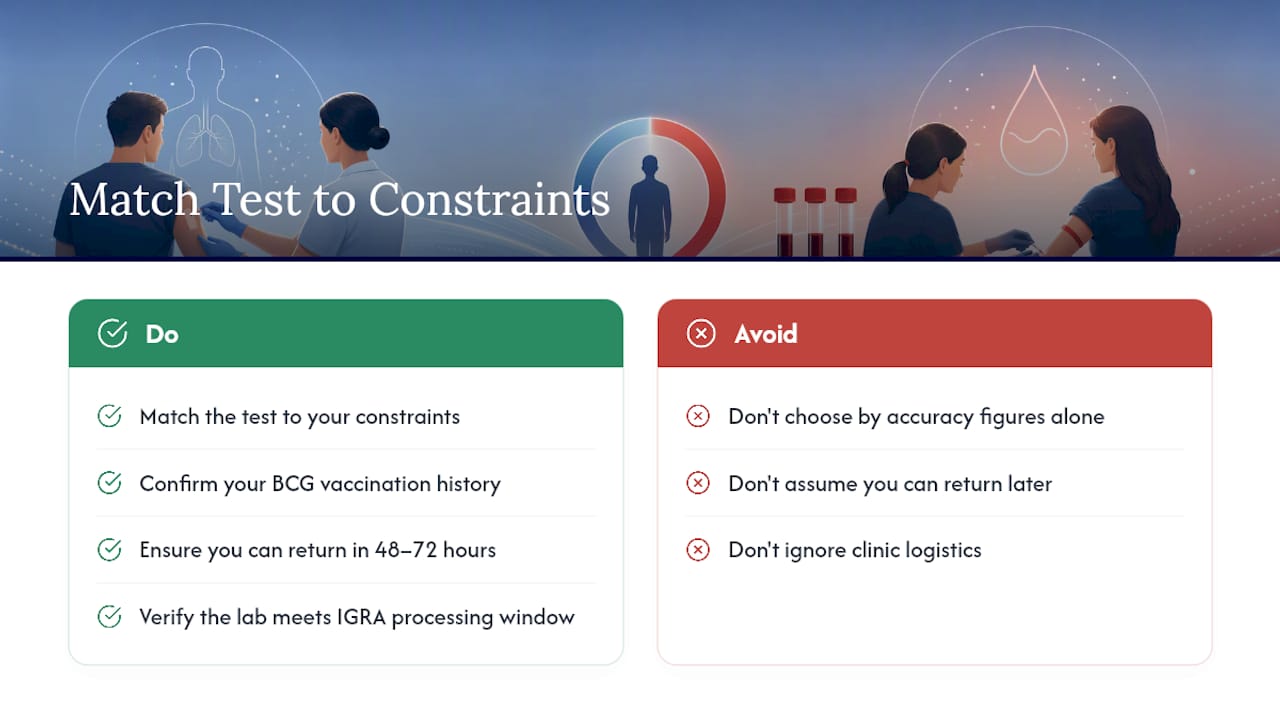
The conventional comparison of these two tests usually stops at sensitivity and specificity numbers, and that misses what actually matters for most people making a real-world decision. Test accuracy differences between IGRA and TST are modest and population-dependent, but the operational gap is not. A missed second appointment turns a valid TST into a wasted test, full stop, and for anyone juggling work schedules, immigration deadlines, or a long commute to a clinic, that risk is often bigger than the accuracy gap between the two methods.
The bigger failure point isn’t which test performs marginally better on paper. It’s choosing a test (or a clinic) that doesn’t match your actual constraints: your BCG history, your ability to return in 48 to 72 hours, and whether the lab handling your blood sample actually meets the processing window IGRA requires. Get those three things right, and either test will serve you well. Get them wrong, and you’ll be retesting regardless of which one you picked first.
— ImmigrationMedicalExams Medical Team
This article is general information, not a substitute for advice from a qualified doctor. Consult a qualified healthcare professional about your own circumstances before acting on anything here.
Sources
- Tuberculin skin test | CDC
- Recommendations for diagnosis of TB infection - WHO consolidated guidelines
- Comparative diagnostic performance of TST and IGRAs (systematic review/meta-analysis)
FAQ
What Is the Most Accurate Way to Test for TB?
Neither test is definitively more accurate across every population. Research shows overlapping sensitivity and specificity between TST and IGRA, so the “best” choice depends on your age, BCG history, and whether you can return for a skin test reading.
Can a Blood Test for TB Be Wrong?
Yes. IGRA can produce false negatives in immunosuppressed people or very young children, and specimens processed outside the required time window can come back indeterminate rather than accurate.
Does a Positive TB Skin Test Mean I Have TB?
Not necessarily active disease. A positive result signals TB infection and requires a medical evaluation, including a chest X-ray, to determine whether the infection is latent or active.
Who Should Not Get a TB Skin Test?
People previously vaccinated with BCG are more likely to get a false-positive TST, which is why the CDC generally prefers IGRA for this group. Very young children under 5, however, are still usually tested with TST rather than IGRA.