
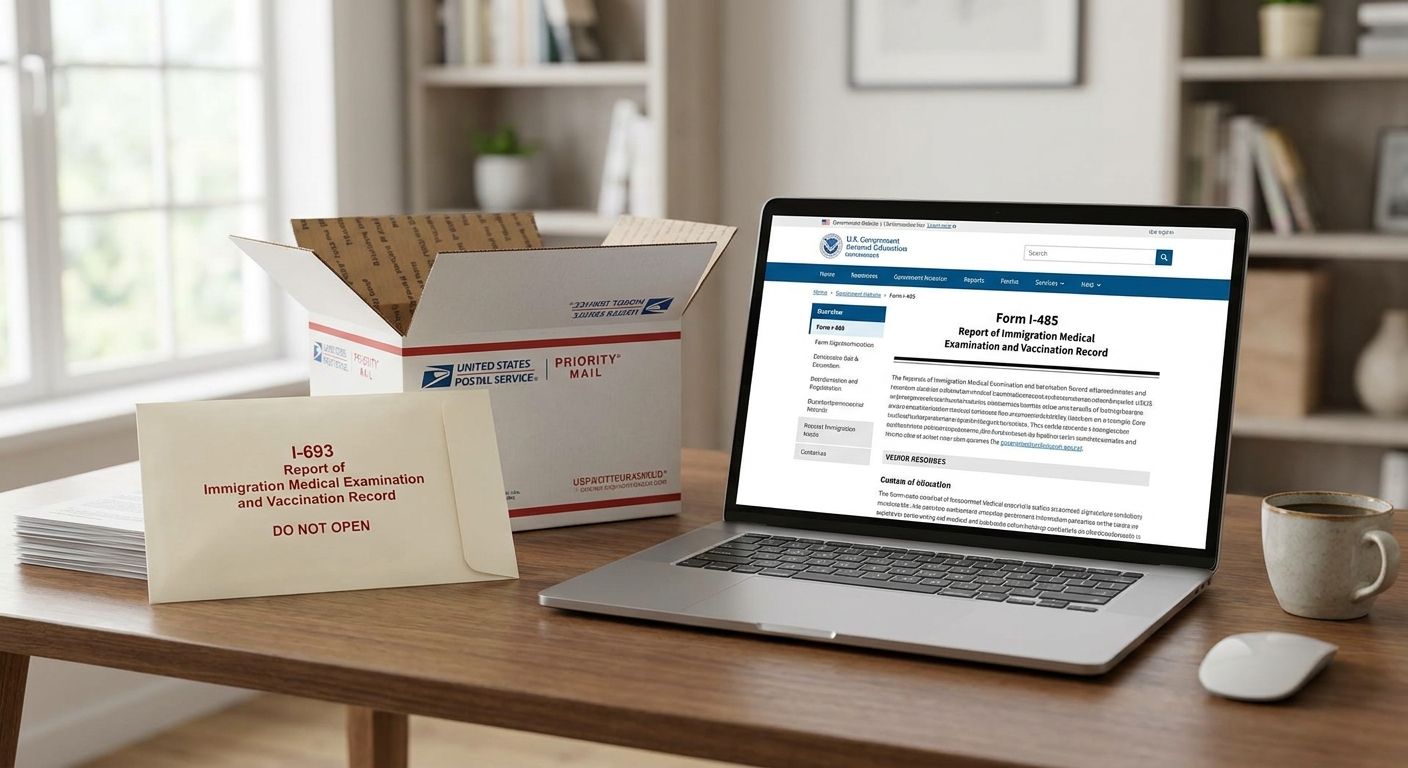
Your sealed Form I-693 envelope has one job: to reach USCIS unopened if you're filing by mail, or to be opened only by you for scanning if you're filing Form I-485 online. Mixing these two paths up is one of the most common reasons applicants call a clinic back for a replacement copy.
- Mail filers keep the sealed I-693 envelope closed and place it directly inside the I-485 mailing packet.
- Online I-485 filers must open the sealed envelope themselves to scan Form I-693 for upload.
- A civil surgeon issues the sealed I-693 envelope; USCIS treats an already-opened envelope from anyone else as a red flag.
- ImmigrationMedicalExams.com in Costa Mesa completes and seals Form I-693 packets for both mail and online filers.
Why This Matters
USCIS treats the seal on your Form I-693 envelope as proof that no one tampered with your civil surgeon's findings after your examination. Break that trust in the wrong way, and you risk a Request for Evidence or a delay while USCIS confirms your results directly with the clinic.
The rule is simple once you know which filing method applies to you, but the instructions read the same regardless of whether you're mailing a paper I-485 or submitting online through your USCIS account. That's where confusion starts.
Do You Open the Sealed I-693 Envelope for Mail or Online Filing?
The answer depends entirely on how you're filing Form I-485, not on anything about your medical exam itself. Here's the direct comparison for 2026 filers:
| Filing Method | What You Do With the Sealed Envelope | Who Opens It |
|---|---|---|
| Mail (paper I-485) | Keep it sealed. Place the unopened envelope inside your mailing packet. | USCIS, upon receipt |
| Online (myUSCIS account) | Open it yourself. Scan Form I-693 and any lab or vaccination records inside. | You, before uploading |
If you're mailing a paper application, do not open the envelope to check your own results, staple it into a stack of documents, or photocopy the contents. An opened seal on a mailed packet looks identical to tampering to a USCIS adjudicator, even if you had good intentions.
If you're filing your USCIS vaccination requirements documentation and Form I-693 online, the opposite is true: USCIS cannot open a physical envelope through your online account, so you're expected to open it, scan every page in order, and upload the complete PDF.
Mail Filing: Keep the Envelope Sealed and Enclosed
When you file a paper Form I-485, your civil surgeon's sealed Form I-693 envelope becomes one physical piece of your mailing packet. Follow these steps:
- Collect the sealed envelope from your civil surgeon at the end of your visit.
- Confirm the civil surgeon's information is printed or stamped on the outside.
- Do not open, unfold, or separate the pages inside.
- Place the entire envelope inside your I-485 mailing envelope along with your other required evidence.
- Mail the complete packet to the correct USCIS filing address for your case type.
If the seal is broken by the time you're ready to mail your packet, whether by accident or during shipping from the clinic, contact your civil surgeon before you mail anything. Most clinics, including ImmigrationMedicalExams.com, will reissue a sealed copy rather than let you submit a compromised envelope.
Online Filing: You Open It to Scan, USCIS Never Sees the Seal
Online I-485 filing works differently because USCIS's digital system only accepts uploaded files, not physical mail. Here's the process:
- Pick up your sealed Form I-693 envelope from your civil surgeon visit.
- Open the envelope yourself once you're ready to file.
- Scan Form I-693 and every supporting page, in the same order the civil surgeon assembled them.
- Upload the complete scan as a single PDF in your myUSCIS account under the medical examination evidence category.
- Keep the physical original in a safe place in case USCIS requests it later.
The seal itself isn't the legal requirement for online filers, the complete and unaltered content is. USCIS never physically handles the envelope in an online case, so opening it is expected, not a violation.
Book Your Immigration Medical Exam
Sealed Form I-693 packets prepared for both mail and online I-485 filing.
Why the Sealed Envelope Rule Exists
A handful of practical reasons drive this requirement, and they explain why USCIS treats it so strictly:
- Chain of custody: the seal shows Form I-693 traveled directly from the civil surgeon's office to USCIS (or to you, for scanning) without a third party altering it.
- Fraud prevention: USCIS has flagged altered or resealed medical forms in past fraud cases, which is why an opened mail-filed envelope draws scrutiny.
- Consistency across filing types: the same Form I-693 content has to hold up whether it arrives as paper or as a scanned PDF.
- Civil surgeon accountability: a sealed, signed packet ties the results back to a specific USCIS-designated civil surgeon who can be contacted if questions come up.
- Applicant protection: keeping the envelope sealed until the right moment protects you from accusations of editing your own medical results.
Related Questions About the Sealed I-693 Envelope
What happens if I accidentally open my sealed envelope before mailing?
Contact your civil surgeon right away and ask about a replacement sealed copy before you submit anything by mail. USCIS may still accept it with an explanation, but a fresh sealed envelope avoids the issue entirely.
Can I photograph or photocopy my sealed Form I-693 before mailing it?
No, doing this requires opening the sealed envelope, which defeats the purpose for mail filers. If you need a personal record, ask your civil surgeon's office whether they retain a copy on file.
Does the sealed envelope expire before I file?
Form I-693 itself carries a validity period tied to your civil surgeon's signature date, not the envelope. Filing promptly after your exam, ideally within the standard 3-business-day completion window most clinics offer, keeps your documentation current when USCIS reviews your case.
Do same-day exam appointments still come with a sealed envelope?
Yes, a same-day appointment still produces a sealed Form I-693 packet at the end of your visit, following the identical mail-versus-online rules described above.
Do 245(i) grandfathered applicants follow a different sealed envelope process?
No, 245(i) grandfathered applicants follow the same sealed envelope rules as any other adjustment of status filer, mail or online.
One mention worth making here: ImmigrationMedicalExams.com in Costa Mesa prepares sealed Form I-693 packets for both filing paths every day, and staff can tell you at checkout exactly how your specific packet should be handled based on how you plan to file.
FAQ
Do I need to keep my Form I-693 envelope sealed for online filing?
No, online I-485 filers must open the sealed envelope themselves to scan Form I-693 and upload it to their USCIS account. The sealing requirement applies to mail-filed packets, not digital uploads.
What happens if USCIS receives an opened sealed I-693 envelope in a mailed packet?
USCIS may flag it for review or send a Request for Evidence questioning whether the contents were altered. Contact your civil surgeon for a replacement sealed copy if your envelope is opened before you mail your packet.
Can I open my sealed I-693 envelope to check my results?
You should not open it if you're filing by mail, since USCIS expects that envelope to arrive sealed. Ask your civil surgeon's office directly if you have questions about your results before mailing anything.
How long does a sealed Form I-693 stay valid before I need to file?
Form I-693 validity is tied to your civil surgeon's signature date, so filing soon after your exam matters more than the envelope's condition. Most clinics complete the form within 3 business days standard, with a 2-day expedited option when scheduling and lab results allow.
Who seals the Form I-693 envelope?
A USCIS-designated civil surgeon seals the envelope at the end of your immigration medical exam. The seal confirms the results traveled directly from the civil surgeon's office without alteration.
Does a sealed I-693 envelope work for VAWA self-petitioners the same way?
Yes, VAWA self-petitioners follow the identical sealed envelope rules for mail or online filing as any other Form I-485 applicant. The medical exam process itself does not change based on petition category.
Can my attorney open my sealed I-693 envelope for me?
An attorney can open it on your behalf if you're filing online and need the scan uploaded, since the requirement is an intact, unaltered scan rather than a physically sealed envelope. For mail filing, the envelope should stay sealed regardless of who assembles the packet.
Is a sealed I-693 envelope required for TPS applicants too?
Sealed envelope rules apply specifically to Form I-485 adjustment of status filings, and TPS applications generally use a different medical exam pathway. Check with your civil surgeon which form and packaging applies to your specific TPS filing.
One Last Thing
Most applicants assume opening the envelope is always wrong, but that instinct backfires for online filers who genuinely need to scan the contents themselves. Ask your civil surgeon at checkout which filing method you're using, so the front desk can tell you exactly what to do with your sealed packet before you leave the building.