

Cut I-693 Costs: Use In Network Pharmacy Vaccines and Titers

Yes, licensed pharmacies can supply vaccines that civil surgeons will accept for Form I-693, and using one before your appointment is one of the smartest ways to save time and money. The catch is documentation. Bring an official record showing your full legal name, date of birth, the vaccine name, and the exact administration date in MM/DD/YYYY format. If you’re mid-series on something like Hepatitis B, get the next scheduled dose done first so your civil surgeon can sign off without delay.
TL;DR:
- Vaccines administered by licensed pharmacies like CVS or Walgreens are accepted if documentation includes full legal name, exact date, and vaccine name in MM/DD/YYYY format.
- The influenza vaccine is only required if the appointment falls within the October 1 to March 31 flu season; COVID-19 is no longer on the mandatory list as of January 20, 2025.
- Civil surgeons often prefer official printed immunization records over informal notes, and mismatched names or dates can cause delays or rework.
- You can get some vaccines or titers done before your appointment, which can prevent delays, with civil surgeons documenting immunities through blood tests if applicable.
- Routine adult vaccines tend to be cheaper at pharmacies than through civil surgeon clinics, especially if covered by insurance, but on-site vaccination at clinics is an option for urgent cases.
Table of Contents
- Which Vaccines Does Form I-693 Actually Require?
- Can Pharmacies Provide Acceptable Vaccines for I-693?
- What to Bring: Your Pre-Exam Document Checklist
- How Do Multi-Dose Series and Titers Affect Your I-693?
- Are Pharmacy Vaccines Cheaper Than Getting Them From a Civil Surgeon?
- What Are the Most Common I-693 Vaccination Errors?
- What Happens During the Civil Surgeon Exam Itself?
- A Specialist’s View on Pharmacy Vaccines and I-693 Paperwork
- Where to Verify These Rules Yourself
- Sources
- FAQ
Which Vaccines Does Form I-693 Actually Require?
The vaccine list on Form I-693 isn’t arbitrary. It’s built from a combination of statutory requirements and additions the CDC has made over the years, and which ones apply to you depends heavily on your age.
Civil surgeons work from these commonly required vaccines, adjusted for age and, in one case, the calendar:
- MMR (measles, mumps, rubella)
- Varicella (chickenpox)
- Tdap (tetanus, diphtheria, pertussis)
- Polio (IPV)
- Hepatitis B
- Hib (Haemophilus influenzae type b, generally for younger children)
- Influenza, required only during flu season, October 1 through March 31
- Pneumococcal
- Hepatitis A
- Meningococcal
- Rotavirus (infants only)
A few points trip people up every filing season. First, influenza is seasonal. If your exam falls outside the October 1 to March 31 window, the civil surgeon marks it not applicable rather than making you chase down a flu shot in July. Our own breakdown of the flu vaccine requirement for I-693 walks through exactly how that window gets applied.
Second, COVID-19 is no longer on the list. As of January 20, 2025, USCIS waived the COVID-19 vaccination requirement for adjustment of status applicants, so don’t waste an appointment slot getting one just for the exam. If you want the full age-by-age breakdown, including which vaccines drop off after certain birthdays, the USCIS vaccination requirements guide covers it in more detail than a quick-reference list ever could.
Can Pharmacies Provide Acceptable Vaccines for I-693?
Yes. CDC’s own technical instructions tell civil surgeons they must review and transfer credible written vaccination histories from any licensed provider, and that explicitly includes pharmacies. You are not required to get every shot at the immigration clinic itself. Civil surgeons are trained to accept outside records and only administer what’s still missing, per the Technical Instructions for Civil Surgeons.
The word “written” matters more than most applicants realize. Telling the civil surgeon “I got my MMR shot a few years ago” won’t cut it, no matter how confident you sound. A record only counts if it includes:
- Your full legal name, spelled exactly as it appears on your ID
- Your date of birth
- The specific vaccine name (not just “shot” or “immunization”)
- The exact administration date, written as MM/DD/YYYY
CVS, Walgreens, Walmart, and Costco all administer routine adult vaccines and generate immunization records that meet this standard, based on USCIS’s own guidance on vaccination requirements. Most of these chains link vaccination history to a patient portal where you can download or print your record the same day you get the shot.
Pro Tip: Log into your pharmacy’s patient portal before you leave the parking lot and download a PDF of your immunization record right then. Portals occasionally lag by a day or two, and you don’t want to be scrambling for a printout the morning of your civil surgeon appointment.
What to Bring: Your Pre-Exam Document Checklist
Walking into your appointment with the right paperwork is the difference between a same-day sealed I-693 and a frustrating follow-up visit. Here’s what to gather beforehand, in order of priority:
- Government-issued photo ID that matches the name on your vaccination records exactly.
- Official pharmacy immunization printouts, not a screenshot of a text message reminder, showing every date in MM/DD/YYYY format.
- Prior lab titer results, if you’ve ever had bloodwork checking immunity levels for measles, varicella, or Hepatitis B.
- Certified translations for any foreign vaccination cards or clinic records not already in English.
Requesting the record itself is usually painless. Log into the pharmacy’s app or website, navigate to “immunization history” or “vaccine records,” and export the official document. If the portal doesn’t cooperate, ask the pharmacist at the counter for a printed record before you leave; most locations can generate one in a few minutes.
Name mismatches cause more delays than any other single issue. If your pharmacy record lists a maiden name, a middle name you don’t normally use, or a slightly different spelling than your passport, flag it before your civil surgeon appointment rather than during it. A quick call to the pharmacy to correct the record on file saves a return trip. For foreign-language vaccination booklets, our guide on adult vaccines for I-693 explains what level of translation and certification civil surgeons typically expect.
How Do Multi-Dose Series and Titers Affect Your I-693?
You don’t need to finish an entire vaccine series before your civil surgeon signs Form I-693. USCIS allows civil surgeons to document a series as “in progress” as long as you’ve received the next dose due on the standard schedule, according to USCIS’s vaccination requirements page. This one rule alone prevents a lot of unnecessary filing delays.
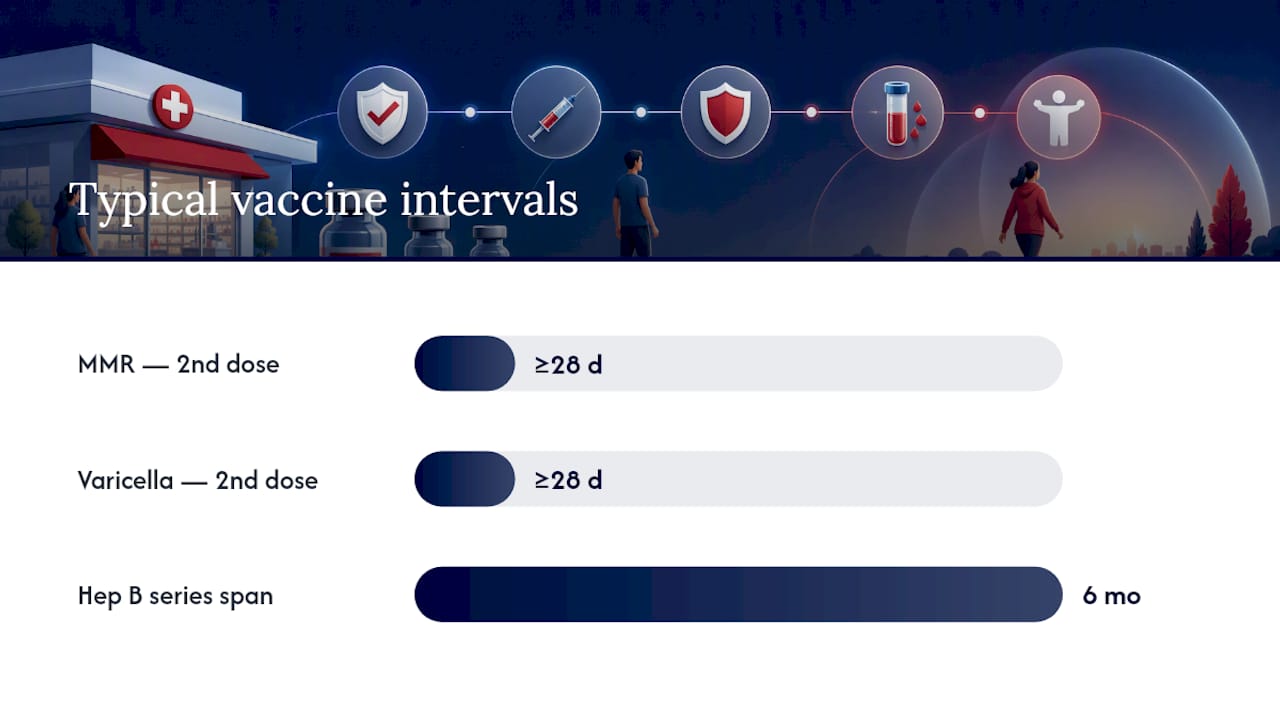
Knowing the typical intervals helps you plan your pharmacy visits so nothing holds up your exam date:
- MMR, second dose given at least 28 days after the first
- Varicella, second dose at least 4 weeks after the first
- Hepatitis B, a 0, 1, 6-month schedule (dose one, then one month later, then five months after that)
- HPV (when applicable), spaced over several months depending on age at first dose
If you can’t get a series started or completed in time, ask about titers. A titer is a blood test that measures existing antibody levels, and it can substitute for vaccination when it shows adequate immunity. Civil surgeons record laboratory evidence of immunity directly on Form I-693 in place of a vaccine dose, which is often faster than starting a series from zero, especially for MMR and varicella. This is one area where working with a civil surgeon who understands the timing math matters. Get the sequencing wrong and you’re looking at a return visit weeks later.
Are Pharmacy Vaccines Cheaper Than Getting Them From a Civil Surgeon?
Usually, yes, and insurance is the reason why. Most health plans cover routine adult vaccines at little or no out-of-pocket cost when administered at an in-network pharmacy, since preventive immunizations are typically classified as covered preventive care. If you’re uninsured, retail pricing at a pharmacy still tends to run lower than paying for the same vaccine bundled into a clinic visit.
Civil-surgeon clinics can and do administer vaccines on-site, and for applicants who need something urgently or who don’t have easy pharmacy access, that convenience is worth the fee. But if you have functioning insurance and some lead time before your appointment, pre-vaccinating elsewhere is usually the cheaper path.
A few practical steps make this strategy actually pay off:
- Call your insurer and ask specifically whether routine immunizations are covered at retail pharmacies, not just doctor’s offices.
- Request an itemized immunization record and a receipt every time you get a shot, even if the visit was free.
- Keep both documents together in one folder, physical or digital, so you’re not hunting for a receipt from three pharmacy visits ago.
What Are the Most Common I-693 Vaccination Errors?
Most vaccination-related delays on Form I-693 trace back to a handful of repeat mistakes, and nearly all of them are avoidable with a five-minute check before your appointment.
- Missing or vague dates. “Spring 2023” isn’t a date USCIS accepts. It needs to be MM/DD/YYYY, full stop.
- Illegible or handwritten records. A pharmacist’s scrawled note on a business card won’t satisfy the standard; get the official printout instead.
- Name or date-of-birth mismatches between your ID and your vaccination record.
- Using an outdated I-693 edition. Form editions change, and civil surgeons must use the current one.
- Assuming verbal history is enough. It never is, no matter how certain you are of your own vaccine history.
- Timing the flu shot wrong, either getting one outside the required season or assuming it’s needed year-round.
If you already have a Request for Evidence, don’t panic. Gather the specific missing documentation the RFE names, get any missing dose or titer completed, and resubmit through a civil surgeon who can properly document and re-seal Form I-693.
What Happens During the Civil Surgeon Exam Itself?
The civil surgeon’s job on exam day is part detective work, part administration. They review every written vaccination record you bring, cross-check it against the age-based requirement list, and determine what’s already satisfied versus what’s still missing.
Here’s what that process typically covers:
- Reviewing pharmacy printouts, prior clinic records, or titer results for completeness
- Administering any next-due dose in a series, or the vaccine itself if you arrive with nothing
- Marking a vaccine “not medically appropriate” when a documented medical reason applies
- Signing and sealing Form I-693 in an envelope, which USCIS requires before the document is considered valid for submission
Do not open that sealed envelope. USCIS can reject Form I-485 filings that don’t include the required I-693 exactly as instructed, sealed and intact, so treat that envelope as untouchable until it reaches the right hands. If you started a vaccine series that isn’t finished, the civil surgeon documents it as in progress and you’ll simply need to complete the remaining doses on the normal schedule, independent of your filing timeline.
A Specialist’s View on Pharmacy Vaccines and I-693 Paperwork
After years of reviewing incoming vaccination records for Form I-693, one pattern stands out: applicants rarely get the vaccines wrong. They get the paperwork wrong. A civil surgeon practice that handles nothing but I-693 exams, day in and day out, spots a mismatched date of birth or a missing lot number in seconds, because that’s the entire job, not a side task squeezed between urgent-care visits.
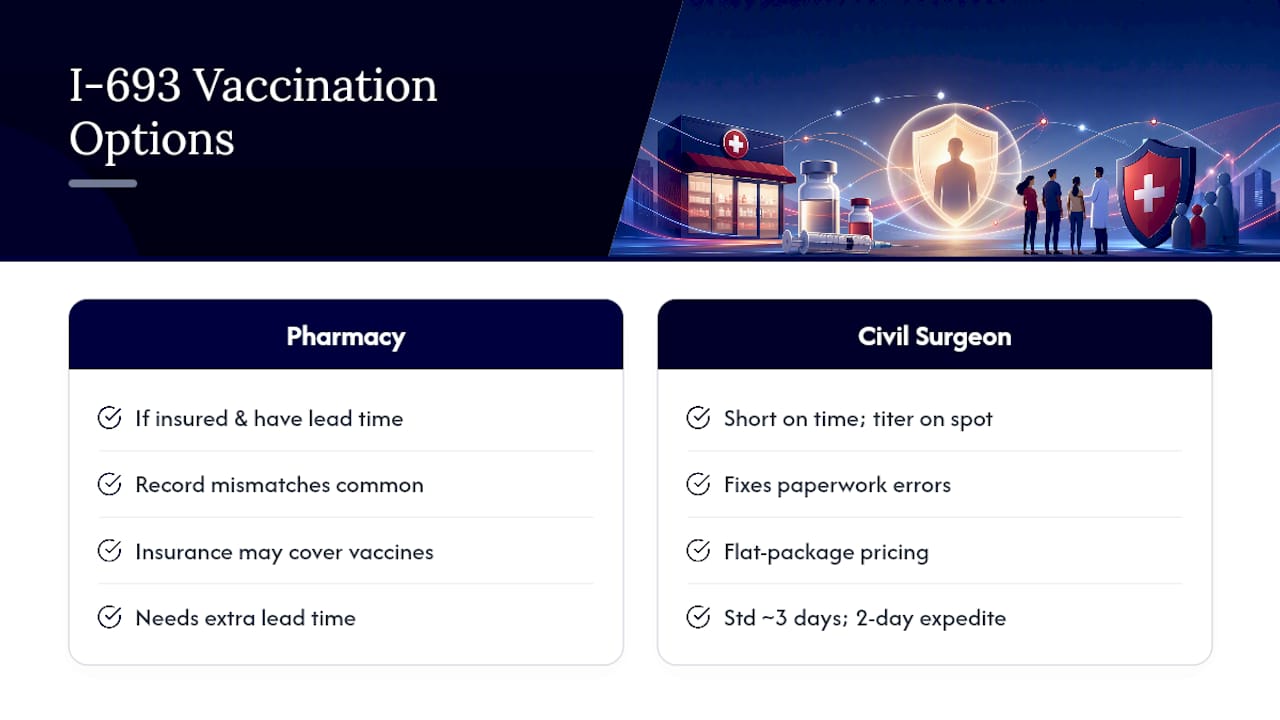
Immigrationmedicalexams has specialized exclusively in immigration medical exams since 2007, with no primary care or sick visits diluting the focus. That specialization shows up in practical ways: flat-package pricing so you’re not surprised by add-on fees, standard processing in about 3 days with a 2-day expedited option when your filing deadline is tight, and 24/7 online scheduling so you’re not stuck waiting for office hours to book. We see a steady stream of applicants who ran into delays, errors, or incomplete vaccination documentation from exams done elsewhere, and pharmacy record mismatches are among the most common culprits.
As a general rule, pre-vaccinate at a pharmacy when you have insurance coverage and enough lead time before your appointment. Get vaccines directly from the civil surgeon when you’re short on time, need a titer interpreted on the spot, or simply want everything handled in one visit.
— ImmigrationMedicalExams Medical Team
Where to Verify These Rules Yourself
Policy details shift, so confirm current requirements directly with these official sources before your exam:
- USCIS Vaccination Requirements
- CDC Technical Instructions for Civil Surgeons
- USCIS Form I-693
- USCIS Policy Manual, Volume 8, Part B, Chapter 9
If your case involves other timing considerations, such as pregnancy or age-related exemptions, our guides on the immigration medical exam step-by-step process and pregnancy-related vaccine deferrals go deeper into those specific rules. Ready to book? Schedule your I-693 exam with a practice that’s focused exclusively on getting this form right the first time.
This article is general information, not a substitute for advice from a qualified doctor. Consult a qualified healthcare professional about your own circumstances before acting on anything here.
Sources
- Vaccination Requirements
- Technical instructions for civil surgeons — Vaccination
- I-693 | Report of Immigration Medical Examination and Vaccination Record
- USCIS Policy Manual: Vaccination Requirement
FAQ
What vaccines are mandatory for Form I-693?
Required vaccines include MMR, varicella, Tdap, polio, Hepatitis B, Hib, pneumococcal, Hepatitis A, meningococcal, and rotavirus, with influenza required only from October 1 through March 31. Exact requirements depend on your age.
What vaccination records are required for Form I-693?
Records must show your full legal name, date of birth, the specific vaccine name, and the exact administration date in MM/DD/YYYY format. Verbal history or informal notes are not accepted.
What vaccinations are required for immigration to the United States?
The list mirrors routine U.S. childhood and adult immunization schedules, adjusted by age, and is set by combined statutory and CDC requirements enforced through Form I-693.
What are the most common I-693 vaccination errors?
The most frequent mistakes are missing or vague dates, illegible records, name or date-of-birth mismatches, outdated form editions, and assuming a verbal vaccine history will be accepted.