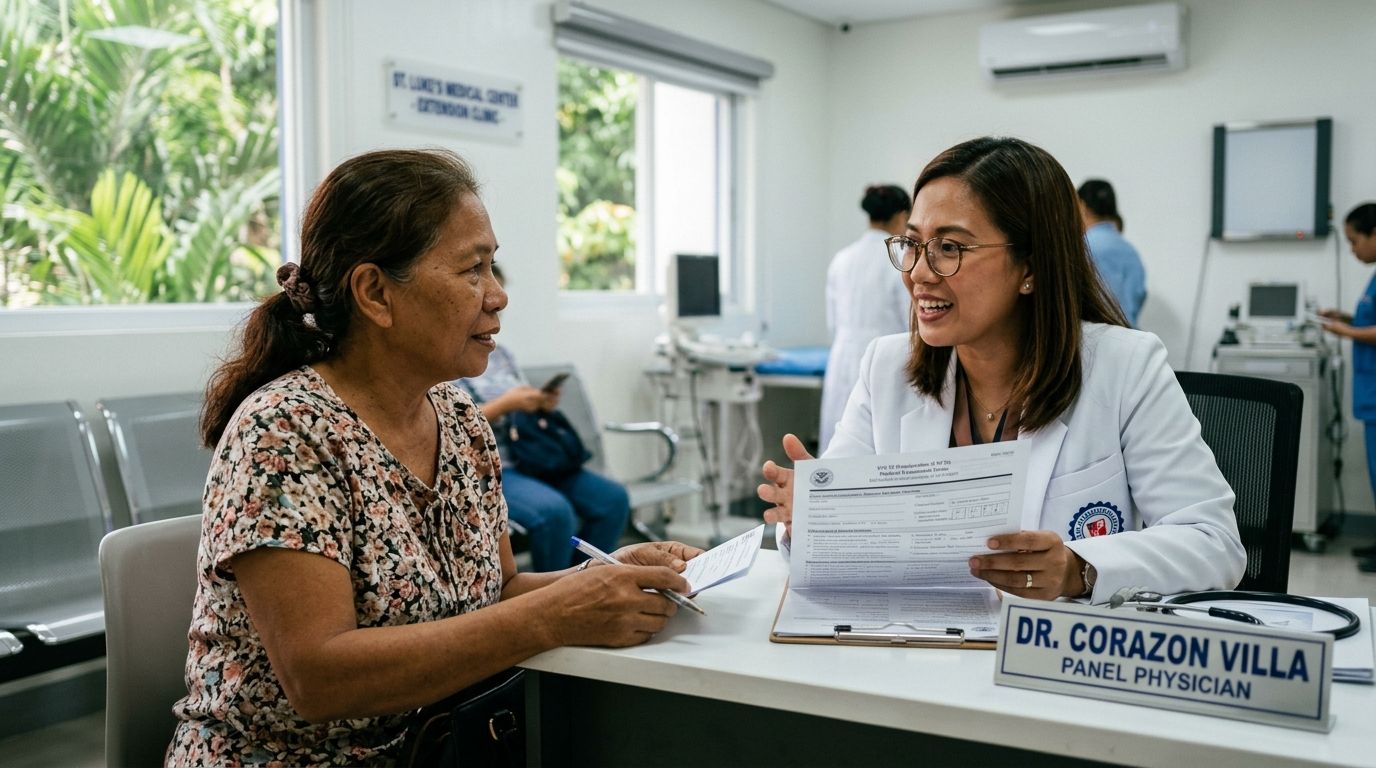
Tagalog-speaking applicants completing an immigration medical exam need clear, accurate communication with their civil surgeon so nothing gets lost between their health history and Form I-693. Vaccination records, past tuberculosis exposure, and current medications all have to be documented correctly, and a language gap at any point in the visit can turn into a delay weeks later at USCIS.
- Tagalog-speaking applicants can request interpreter support for their immigration medical exam to answer health history questions accurately.
- ImmigrationMedicalExams.com in Costa Mesa coordinates the civil surgeon exam, TB testing, and vaccination review needed for Form I-693 in 2026.
- Gather Philippine vaccination and medical records before your appointment instead of trying to recall dates from memory.
- Never let a minor child interpret sensitive health history during a civil surgeon visit.
Why interpreter access matters for Form I-693
Form I-693 asks the civil surgeon to document your vaccination history, mental and physical health conditions, and any history of substance use or communicable disease. If a question gets misunderstood in either direction, the civil surgeon may record an inaccurate answer or leave a section incomplete, and USCIS can issue a Request for Evidence over it.
This matters more for applicants coming from the Philippines because vaccination schedules, record formats, and even how conditions are named can differ from what a US clinic expects. A civil surgeon who can confirm details in Tagalog, or through a competent interpreter, is far less likely to misread a record or miss a required vaccine.
The fix isn't complicated. It just requires a little planning before your appointment instead of during it.
Update your interpreter arrangements before you book
- Ask when scheduling whether Tagalog interpretation is available by phone, video, or in person
- Bring an adult family member or friend who is comfortable with medical vocabulary in both languages
- Avoid using a child under 18 to interpret health history, especially anything involving mental health or substance use
- Consider a professional medical interpreter if your history includes a complex diagnosis or past hospitalization
- Confirm the interpreter plan again the day before your visit so there's no confusion at check-in
ImmigrationMedicalExams.com works with patients from a range of language backgrounds and can talk through interpreter options when you book your appointment.
Gather your vaccination and medical records early
Collecting your records before the appointment saves the most time. USCIS-designated civil surgeons need dates, vaccine names, and dosage counts, not a general memory of "I think I had that one."
- Request written vaccination records from any clinic or hospital in the Philippines where you were vaccinated
- Ask for an English translation if the original record is only in Filipino or a regional dialect
- Bring any prior TB skin test, TB blood test, or chest X-ray results and their dates
- List current medications, including the generic or English name if you only know the Filipino brand name
- Note any past TB diagnosis or treatment, even if it was fully resolved years ago
Complete your telehealth pre-screening with language support
Many applicants can complete a telehealth pre-screening before the in-person exam. If you request interpreter support for this call the same way you would for the main appointment, you'll walk into the exam with your paperwork already sorted out. See the full telehealth pre-screening guide for what to expect on that call.
- Schedule the pre-screening call at a time when your interpreter is available too
- Have your vaccination records and ID ready before the call starts
- Write down your questions in Tagalog beforehand so nothing gets lost mid-conversation
- Confirm your in-person appointment date and time before you hang up
Prepare to answer health history questions clearly
The civil surgeon has to ask about chronic conditions, mental health history, and substance use as part of the standard exam. Answer honestly regardless of which language you're using; the goal is an accurate Form I-693, not a fast one.
- List any chronic conditions such as diabetes, hypertension, or asthma
- Mention any past mental health treatment, even if it's no longer active
- Disclose any history of substance use, since USCIS instructions require this
- Note any prior TB exposure or a family member's TB diagnosis
- Bring a current medication list with dosages, not just names
Review vaccination requirements before your visit
USCIS requires specific vaccines for Form I-693, and requirements are periodically updated. Reviewing the current vaccination requirements before your appointment means you and your civil surgeon aren't figuring out gaps in the exam room.
- Check which vaccines are currently required for your age group in 2026
- Bring proof of MMR, Tdap, and varicella vaccination if you have it
- Ask about any medical exemption if a vaccine is contraindicated for you
- Confirm with the civil surgeon, through your interpreter if needed, which doses you may still need that day
Review your completed Form I-693 before it's sealed
Once the civil surgeon finishes documenting your exam, ask for a summary review before the form goes into its sealed envelope. This is your last chance to catch an error.
- Have your interpreter confirm the summary matches what you actually told the civil surgeon
- Verify your name and date of birth are spelled and entered correctly
- Confirm your vaccination and TB testing results are fully recorded
- Ask how the completed form will be delivered or mailed to you or your attorney
- Do not accept a sealed envelope without understanding what's inside it
Our guide to preparing questions for your civil surgeon visit has a longer list of what to ask before you leave the exam room.
Comparing interpreter options for your exam
| Option | Best for | Key limitation |
|---|---|---|
| Bring your own bilingual family member | Applicants with a trusted English-Tagalog speaker available | May not know precise medical terminology, which risks inaccurate translation |
| Use a clinic that offers Tagalog interpreter access | Applicants who want a coordinated exam without arranging their own interpreter | Availability depends on scheduling and civil surgeon staffing that day |
| Hire a professional medical interpreter | Applicants with a complex medical history or attorney involvement | Requires an extra step to arrange before the appointment |
| Attempt the exam without interpreter support | Applicants fully comfortable with English medical terms | Higher risk of miscommunication on TB and vaccination history questions |
Verdict: for most Tagalog-speaking applicants, arranging interpreter access through the clinic or a trusted bilingual adult ahead of time is the safer path; skipping interpretation entirely is only reasonable if you're genuinely fluent in medical English.
Schedule Your Immigration Medical Exam
Book online and mention your language preference when you schedule.
Common mistakes Tagalog-speaking applicants make
- Bringing a child to interpret sensitive history. A minor shouldn't be asked to translate questions about mental health or substance use.
- Assuming Philippine vaccination records automatically satisfy USCIS requirements. Records still need to be reviewed against current USCIS standards, and translation helps the civil surgeon confirm dates and vaccine names.
- Leaving out past TB treatment because it feels resolved. USCIS instructions require it to be documented even if it was treated years ago.
- Confusing a same-day appointment with same-day completion. A same-day exam slot doesn't always mean the full I-693 is finished that day; standard completion is typically three business days, with an expedited two-day option when everything qualifies.
- Waiting until the exam day to think about an interpreter. Arranging language support in advance avoids rushed, incomplete answers during the visit.
FAQ
Do I need to bring my own Tagalog interpreter to my immigration medical exam?
No, but arranging one in advance helps. Ask the clinic when you schedule whether Tagalog interpretation is available, or bring a trusted adult who can interpret medical terms accurately.
Can a family member interpret for me during my civil surgeon visit?
Yes, as long as they're an adult comfortable with medical vocabulary in both languages. Avoid using a minor child, especially for questions about mental health or substance use history.
Will USCIS accept Form I-693 if my exam used interpreter support?
Yes. USCIS does not require the exam to be conducted in English; it requires the civil surgeon to document your history accurately, and interpreter support helps make that possible.
How do I prepare my Philippine vaccination records for my I-693 exam?
Bring the original records and, if possible, an English translation. The civil surgeon needs vaccine names and dates to match them against current USCIS requirements.
What happens if I don't understand a question during my exam?
Say so right away and ask for clarification or interpreter support. A misunderstood answer recorded on Form I-693 can trigger a Request for Evidence from USCIS later.
How long does the immigration medical exam take for non-English speakers?
The exam itself takes about the same time regardless of language, though using an interpreter can add time to the health history portion. Standard completion of Form I-693 is typically three business days.
Can I complete my telehealth pre-screening in Tagalog?
Ask when you schedule the pre-screening whether interpreter support is available for that call. Having it set up in advance keeps your in-person visit shorter.
What if my vaccination record is incomplete when I arrive for my exam?
The civil surgeon can administer required vaccines that day when medically appropriate. Bring whatever documentation you have, even if it's partial, so the civil surgeon can identify the gaps.
One last thing
USCIS civil surgeon guidance doesn't require a certified court interpreter for the exam itself, but it does expect the interpreter to be a competent adult without a conflict of interest, so your immigration attorney generally shouldn't serve as your medical interpreter. Bringing a separate, trusted adult for that role keeps your legal representation and your medical documentation cleanly separated on Form I-693.