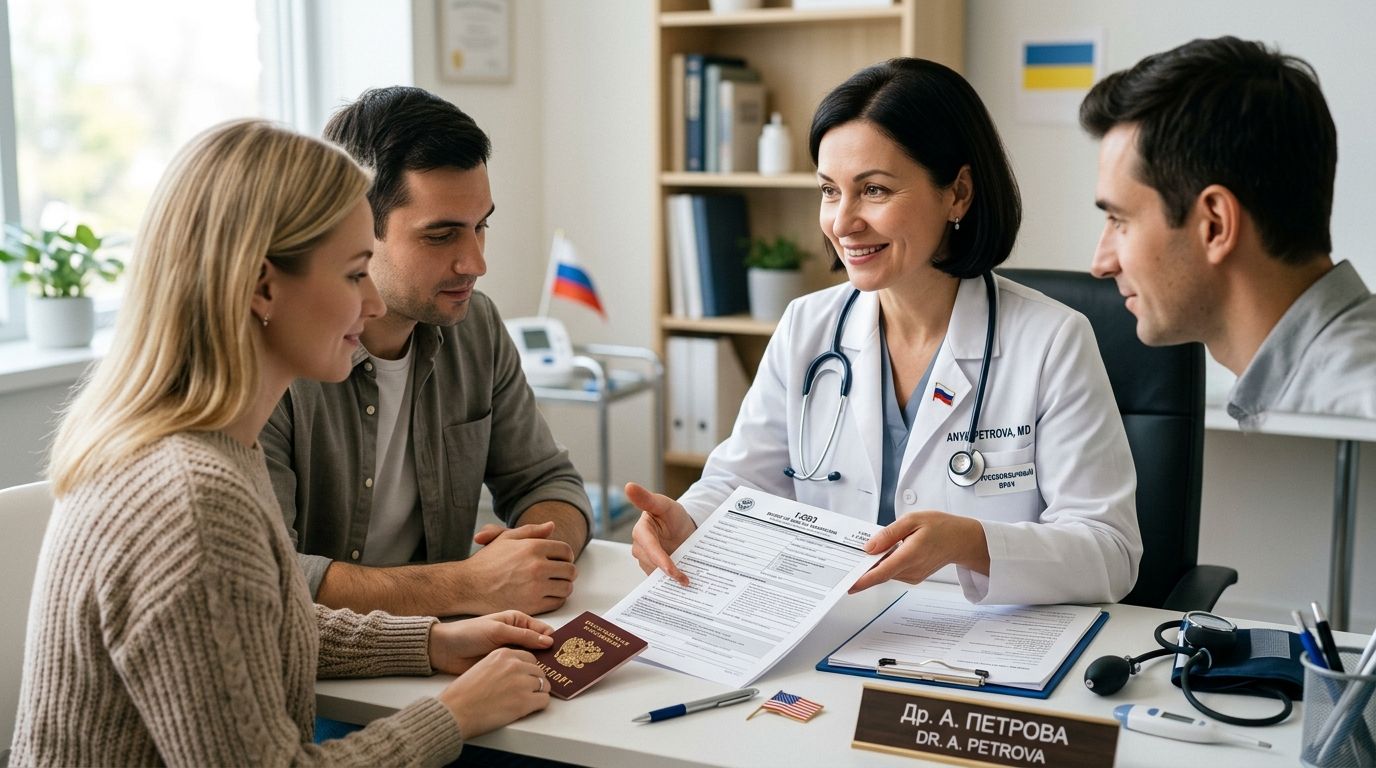
Immigration medical exam for Russian-speaking applicants means completing Form I-693 with a civil surgeon who can communicate clearly in Russian or coordinate a qualified interpreter, so nothing about your vaccination history or medical background gets lost in translation. This matters more than most applicants expect, because a single misunderstood question about a childhood vaccine can delay your green card case by weeks.
- Immigration medical exam for Russian-speaking applicants moves faster with in-house Russian support or a professional interpreter, not a family member.
- Applicants who received the BCG vaccine in Russia or the former Soviet Union often need an IGRA blood test instead of a TB skin test.
- Certified translations of Russian vaccination records prevent civil surgeons from guessing at your immunization history.
- Standard Form I-693 completion takes 3 business days, with a 2-business-day expedited option when scheduling and lab results allow.
Why this matters for Russian-speaking applicants
USCIS requires the civil surgeon to gather a full medical history and vaccination record during your immigration medical exam, and that conversation has to be accurate. If your civil surgeon and you don't share a language, the exam either slows down while everyone works around the gap, or worse, something gets recorded incorrectly on your Form I-693.
Applicants who grew up with the Soviet-era or Russian immunization schedule also face a specific clinical wrinkle: the BCG vaccine, given routinely for tuberculosis prevention in Russia and much of the former Soviet Union, is not part of the standard US childhood schedule. That single fact changes how your civil surgeon should test you for TB, and it's worth understanding before your appointment date, not during it.
ImmigrationMedicalExams.com is a Costa Mesa clinic staffed by USCIS-designated civil surgeons that has handled Form I-693 exams since 2007, serving applicants across Orange, Los Angeles, Riverside, San Diego, and San Bernardino counties. The clinic's approach applies the same way to any applicant, but a few extra steps make the process smoother if Russian is your primary language.
Confirm your civil surgeon offers Russian-language support
Don't assume every civil surgeon's office has this covered. Ask directly before you book.
- Call ahead and ask whether staff or the civil surgeon speak Russian, or whether a professional interpreter is arranged for your visit.
- Avoid relying on a phone-based general interpreter line for a medical history review if a Russian-speaking option exists.
- If the office uses an interpreter service, ask whether it's built into your appointment time or scheduled separately.
- Confirm the interpreter (in person or by phone) will be present for the full exam, not just the intake paperwork.
Gather and translate your vaccination records
USCIS wants your vaccination history documented on Form I-693, and Russian-language immunization cards are common among applicants from Russia, Ukraine, Kazakhstan, and other former Soviet states.
- Bring your original Russian-language immunization card (privivochny pasport) to the appointment.
- Get a certified English translation ahead of time if your civil surgeon's office doesn't provide translation on-site.
- Check the specific USCIS vaccination requirements for your I-693 medical exam so you know which vaccines the civil surgeon must verify or administer.
- If your card lists vaccines under Russian names (like AKDS instead of DTaP), let the civil surgeon know so nothing gets misread as missing.
Prepare for TB testing if you received the BCG vaccine
This is the single biggest clinical difference for applicants raised in Russia or the former Soviet Union. BCG vaccination is standard there and is known to cause false-positive results on the traditional tuberculin skin test (TST).
- Tell your civil surgeon upfront if you received the BCG vaccine as a child, even if you're not certain of the exact date.
- Ask whether the office uses an IGRA blood test (such as QuantiFERON-TB Gold), which current CDC guidance recognizes as more accurate than the skin test for people with a BCG history.
- If a skin test is used instead and comes back positive, expect a follow-up chest X-ray to rule out active TB, which adds time to your exam.
- Don't skip this conversation to save time. A missed BCG disclosure is one of the most common causes of extra testing rounds for this applicant group.
Match your name and documents exactly to your passport
Name transliteration from Cyrillic to Latin script varies by document, and a mismatch between your Form I-693 and your passport or green card application can trigger a request for evidence.
- Bring your passport, and if available, your visa or prior immigration documents, to every appointment.
- Point out to staff which spelling of your name should appear on Form I-693, matching your official USCIS filing exactly.
- Flag any documents (birth certificate, prior medical records) where your name appears with a different transliteration.
- Double-check the completed form before it's sealed, since corrections after sealing require a new visit.
Bring a certified translator or interpreter if your civil surgeon doesn't speak Russian
A qualified interpreter protects the accuracy of your exam. An untrained one, even a well-meaning relative, can introduce errors.
- Ask if the clinic can arrange a professional Russian interpreter for the visit.
- If you bring your own interpreter, choose someone comfortable with medical vocabulary, not just conversational Russian.
- Avoid using young children as interpreters for sensitive medical history questions.
- Confirm the interpreter will stay for the entire visit, including any vaccination discussion.
Ask about telehealth pre-screening before your in-person visit
Some offices offer a remote pre-screening step to sort out vaccination history and paperwork questions before you show up. Learn more about how to complete a telehealth pre-screening before your exam if language or document gaps have you worried about your appointment.
- Use the pre-screening call to flag your BCG vaccination history and any Russian-language documents in advance.
- Ask whether an interpreter can join the pre-screening call as well as the in-person exam.
- Confirm which documents to bring based on what comes up during the pre-screening conversation.
- Remember that pre-screening does not replace the required physical exam. It just makes the in-person visit shorter and smoother.
Confirm your appointment format and timeline
Timing matters more when translation or interpreter coordination is part of the visit.
- Ask whether same-day appointments are available if your deadline is close.
- Confirm standard completion runs 3 business days, with a 2-business-day expedited option when scheduling, lab results, and vaccination requirements allow.
- Build in extra time if you expect to need an interpreter scheduled separately from your exam slot.
- Ask about online scheduling if you want to book outside regular office hours.
Comparison: language support options for this exam
| Option | Best for | Key limitation |
|---|---|---|
| Civil surgeon office with in-house Russian-speaking staff | Applicants who want direct communication with no third party involved | Fewer offices offer this compared to English-only clinics |
| Civil surgeon office with a professional interpreter service | Applicants whose civil surgeon doesn't speak Russian | Adds a scheduling step to confirm interpreter availability |
| Telehealth pre-screening before the in-person exam | Applicants who want vaccination and document questions resolved before appointment day | Doesn't replace the required in-person physical exam |
| A family member or friend as an informal interpreter | Simple check-in questions only | Not reliable for a formal medical history review; can affect accuracy on Form I-693 |
The clearest verdict: a professional interpreter or bilingual civil surgeon beats an informal one for anything that ends up written on Form I-693.
Common mistakes Russian-speaking applicants make
- Not mentioning a BCG vaccine history. This is the most frequent cause of an unnecessary positive TB skin test result in this applicant group.
- Bringing an untranslated vaccination card and expecting staff to interpret it on the spot. A certified translation ahead of time saves an appointment cycle.
- Using a young child or untrained relative as the interpreter for a formal medical history review, which increases the risk of inaccurate answers on Form I-693.
- Assuming a Russian immunization schedule automatically satisfies USCIS requirements. Some vaccines given in Russia don't map directly onto the US-recognized schedule, and gaps need to be addressed at the exam.
- Not confirming the name spelling on Form I-693 matches the passport exactly, which can trigger a correction visit later.
Schedule your immigration medical exam
Book online with a civil surgeon experienced in multilingual Form I-693 exams.
FAQ
What is the best language option for Russian-speaking Form I-693 applicants?
A civil surgeon office with in-house Russian-speaking staff or a professional interpreter service is the most reliable option in 2026. Informal interpreters, including family members, carry more risk of miscommunication on a formal medical history.
Do I need a certified translator for my immigration medical exam?
You need a certified English translation of any Russian-language vaccination records the civil surgeon can't read directly. For spoken communication during the exam, a professional interpreter is strongly preferred over an untrained one.
Will my BCG vaccine scar cause problems with TB testing?
A BCG vaccination history can cause a false-positive result on the traditional TB skin test. Current CDC guidance favors an IGRA blood test, such as QuantiFERON-TB Gold, for applicants with a known BCG history.
How do I bring my Russian vaccination records to the exam?
Bring your original Russian-language immunization card along with a certified English translation if your civil surgeon's office doesn't handle translation on-site. This prevents guesswork on Form I-693.
Can I bring my own interpreter to a civil surgeon visit?
Yes, you can bring your own interpreter, but choose someone comfortable with medical vocabulary rather than a young child or casual acquaintance. A qualified interpreter protects the accuracy of your medical history.
How long does the immigration medical exam take for non-English speakers?
The exam itself takes about the same time as for English speakers when a bilingual civil surgeon or interpreter is already arranged. Delays happen mostly when interpretation has to be coordinated on the spot.
Is a same-day appointment available for Russian-speaking applicants?
Same-day appointments may be available depending on scheduling, but confirm in advance that Russian-language support or an interpreter can be arranged for that same slot.
What if my Russian vaccination record doesn't match the US immunization schedule?
The civil surgeon will identify any gaps between your Russian vaccination history and the current USCIS-recognized schedule, and administer required vaccines during your visit when applicable.
One last thing
The detail applicants overlook most often isn't the language barrier itself, it's the BCG vaccine question. Answering it clearly, before the civil surgeon reaches for a TB skin test, is what actually saves a second appointment in 2026.