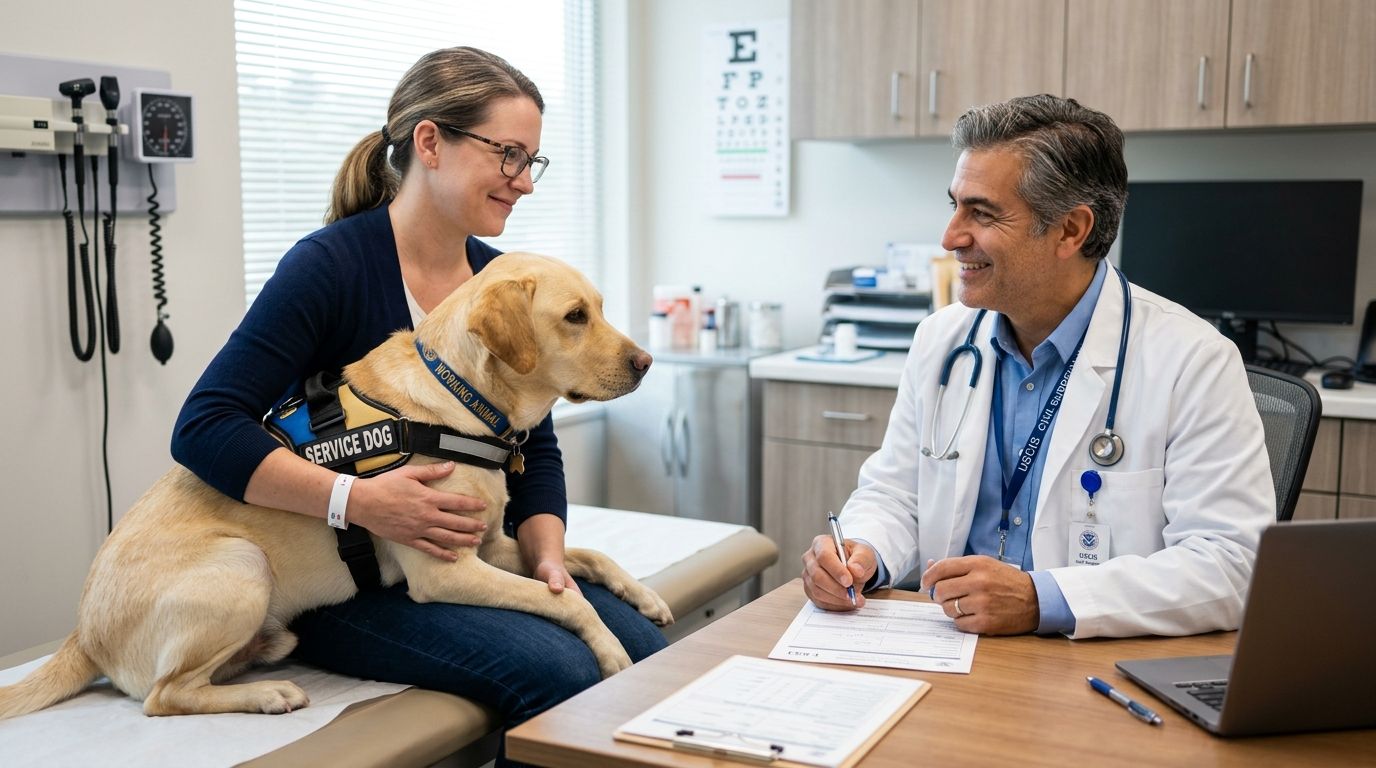
Applicants with a service animal can complete their USCIS Form I-693 immigration medical exam the same way any other applicant does, with the animal permitted into the exam space under the same access rules that apply to any medical office. The exam itself does not change based on whether you use a service animal — the civil surgeon still completes a physical exam, reviews your vaccination record, and orders tuberculosis testing when required. What changes is how you plan the visit so your appointment runs smoothly for you and your animal.
- An immigration medical exam service animal visit follows standard ADA access rules — the animal is allowed in the exam space, not just the waiting room.
- Form I-693 does not ask about disability status or service animal use, so nothing about your animal appears on the form.
- Call ahead before your appointment so scheduling can plan exam room space and timing around your animal.
- Emotional support animals do not have the same legal access as trained service animals under the ADA.
- Same-day and standard 3-business-day exam options both work for applicants with a service animal.
Why this matters for applicants with a service animal
Many applicants worry that bringing a service animal to a civil surgeon office will complicate an already document-heavy process. It shouldn't. Under the Americans with Disabilities Act, medical offices open to the public — including civil surgeon clinics like ImmigrationMedicalExams.com — generally must allow trained service animals into the same areas patients can access, including exam rooms.
The bigger risk for this group isn't access. It's timing and communication. TB testing may require a return visit to read results, vaccination review takes extra minutes if records are incomplete, and a rushed or unplanned visit makes those steps harder to manage with an animal in tow. Planning ahead in 2026 solves nearly all of it.
Confirm what counts as a service animal before you schedule
Start by knowing the legal definition you're working with, because it determines what access rules apply.
- A service animal under the ADA is a dog (or in limited cases, a miniature horse) individually trained to perform a task related to a disability.
- Emotional support, comfort, or companion animals are not covered under the ADA service animal definition, even with a letter from a provider.
- Staff at a medical office may ask only two questions: whether the animal is required because of a disability, and what task it's trained to perform.
- No documentation, certification, or vest is legally required for a service animal to be admitted.
- If your animal is an emotional support animal rather than a task-trained service animal, call the office in advance to ask about its policy before your exam date.
Notify the clinic when you book your appointment
Don't wait until you arrive to mention your service animal. A quick note at booking lets the front desk plan exam room space and appointment order.
- Mention your service animal when you schedule online or by phone, not on arrival.
- Ask whether the exam room has enough space for both you and a larger service animal during the physical exam.
- If you're using the telehealth pre-screening option to handle part of your visit remotely, complete that step first so less time is needed on-site.
- Flag any timing constraints tied to your animal's care routine, such as feeding or bathroom breaks, so the front desk can build in buffer time.
- Ask about parking and building access at 2900 Bristol St. if you're arriving with mobility equipment alongside your service animal.
Gather your documents the same way any applicant would
Your service animal doesn't change your paperwork requirements. Form I-693 asks about your medical history and vaccination record — nothing about disability status or service animal use appears anywhere on the form.
- Bring your government-issued photo ID and any USCIS appointment notice.
- Bring your vaccination records or old shot records if you have them, since incomplete records slow down the vaccination review step.
- Bring a list of current medications and any prior TB test or treatment history.
- If a previous immigration medical exam was incomplete or filled out incorrectly elsewhere, bring those records too — a civil surgeon can often review and correct gaps rather than starting from zero.
- Leave paperwork about your service animal at home. It isn't part of your I-693 packet and isn't reviewed by USCIS.
Plan for TB testing and the vaccination review with your animal present
Tuberculosis screening is where timing matters most for this group. A blood test (IGRA) is the most common method and typically returns results quickly, while a skin test (PPD) requires a return visit 48 to 72 hours later to read the result.
- Ask which TB testing method the clinic uses for your exam, since it affects how many trips you need to make.
- If a skin test is used, plan your animal's care schedule around a second short visit for the reading.
- Bring any prior TB test results or chest X-ray reports you have, since documented prior results can affect what testing is needed.
- Review your USCIS vaccination requirements before your visit so you know which vaccines you may need and can ask questions during the exam rather than after.
- If you need a required vaccine at the visit, factor a few extra minutes into your appointment window.
Choose an appointment slot that reduces stress for you both
A rushed appointment is harder to manage with a service animal than a longer, planned one.
- Ask for the earliest available slot of the day, when wait times are typically shortest.
- Ask whether a same-day appointment is available if your deadline is close, and confirm which components can be completed that day.
- If your timeline allows it, the standard 3-business-day completion window gives more flexibility than a compressed schedule.
- Ask about the 2-business-day expedited option if you're working against a filing deadline, understanding it depends on scheduling, lab results, required vaccinations, and any additional documentation.
- Build in 15 to 20 extra minutes beyond your scheduled slot for check-in and paperwork.
Review Form I-693 before it's sealed
Once your civil surgeon completes the exam, they'll finish Form I-693 and seal it for submission to USCIS. This is your last chance to catch an error.
- Confirm your name, date of birth, and A-number match your USCIS documents exactly.
- Ask the civil surgeon to walk through the vaccination and TB testing sections before the form is sealed.
- Do not open a sealed I-693 packet yourself — a broken seal can cause USCIS to reject it.
- If you're mailing the packet yourself rather than filing online, review how a sealed I-693 packet should be handled so you don't break the seal by accident.
- Ask for a copy of your appointment summary before you leave, separate from the sealed form.
Comparing appointment options for applicants with a service animal
| Option | Best for | Key limitation |
|---|---|---|
| Standard 3-business-day exam | Applicants with flexible USCIS deadlines who want time to gather vaccination records | Not built for last-minute filing deadlines |
| 2-business-day expedited exam | Applicants with a near-term filing deadline in 2026 | Depends on scheduling, lab results, and required vaccinations |
| Same-day appointment | Urgent scheduling needs when slots are open | Availability depends on same-day scheduling capacity |
| Telehealth pre-screening plus in-person visit | Applicants who want to shorten time spent in the exam room | Doesn't replace the required in-person physical exam and testing |
The right choice for most applicants with a service animal is the standard 3-business-day exam booked with advance notice to the front desk — it gives the most scheduling flexibility around TB test readings and vaccination review.
“Your service animal changes how you plan the visit, not what the civil surgeon puts on Form I-693.”
Common mistakes applicants with a service animal make
- Assuming they must explain their disability to clinic staff. Staff can only ask if the animal is required for a disability and what task it performs — nothing more.
- Bringing an emotional support animal expecting the same access as a trained service animal. ADA access rules don't extend to emotional support animals in the same way.
- Skipping the advance heads-up to scheduling. Showing up unannounced with a larger animal can mean a tighter exam room than expected.
- Forgetting that a skin-test TB reading requires a second visit. Applicants plan for one appointment and then scramble to arrange animal care for a return visit 48 to 72 hours later.
- Confusing a same-day appointment with same-day completion of the full exam. Lab work, TB testing, and vaccination review still take processing time even when the visit itself happens the same day.
Schedule Your Immigration Medical Exam
Book online 24 hours a day and mention your service animal when you schedule.
FAQ
Can I bring a service animal to my immigration medical exam?
Yes. Medical offices covered by the ADA, including civil surgeon clinics, generally must allow a trained service animal into patient areas such as exam rooms. Call ahead so the front desk can plan exam room space around your 2026 appointment.
Do I need paperwork for my service animal at the exam?
No. The ADA does not require certification, registration, or a vest for a service animal, and Form I-693 does not ask about disability status or service animal use. Staff may only ask if the animal is required for a disability and what task it performs.
Are emotional support animals treated the same as service animals?
No. The ADA defines a service animal as a dog trained to perform a specific task related to a disability, and emotional support animals generally fall outside that definition. Call the clinic in advance if you plan to bring an emotional support animal.
Will having a service animal affect my Form I-693 results?
No. Form I-693 covers your physical exam, vaccination record, and required testing such as tuberculosis screening. Nothing about a service animal or disability status appears on the form.
How long does an immigration medical exam take with a service animal?
The exam itself takes about the same time as any other applicant's visit. Build in 15 to 20 extra minutes for check-in, and plan for a possible return visit if your TB test is a skin test rather than a blood test.
Can I get a same-day immigration medical exam with a service animal?
Same-day appointments may be available depending on scheduling, but the full exam still includes lab work, TB testing, and vaccination review, which affects when Form I-693 is completed. Confirm availability when you book.
What if my TB test requires a second visit?
A tuberculosis skin test (PPD) requires a return visit 48 to 72 hours later to read the result, while a blood test (IGRA) does not. Ask which method your exam uses so you can plan your animal's care around any second visit.
Does USCIS need to know I use a service animal?
No. Service animal use is not part of the Form I-693 medical exam and is not something USCIS reviews as part of your immigration medical exam packet.
One last thing
The part applicants with a service animal overlook most isn't access — it's the TB test timeline. A skin test reading 48 to 72 hours later is the one step that can force a second trip in 2026, so ask about the blood test option (IGRA) when you schedule if a single-visit exam matters to you. ImmigrationMedicalExams.com has performed immigration medical exams only, since 2007, which is why front-desk staff can answer that question before you arrive.