
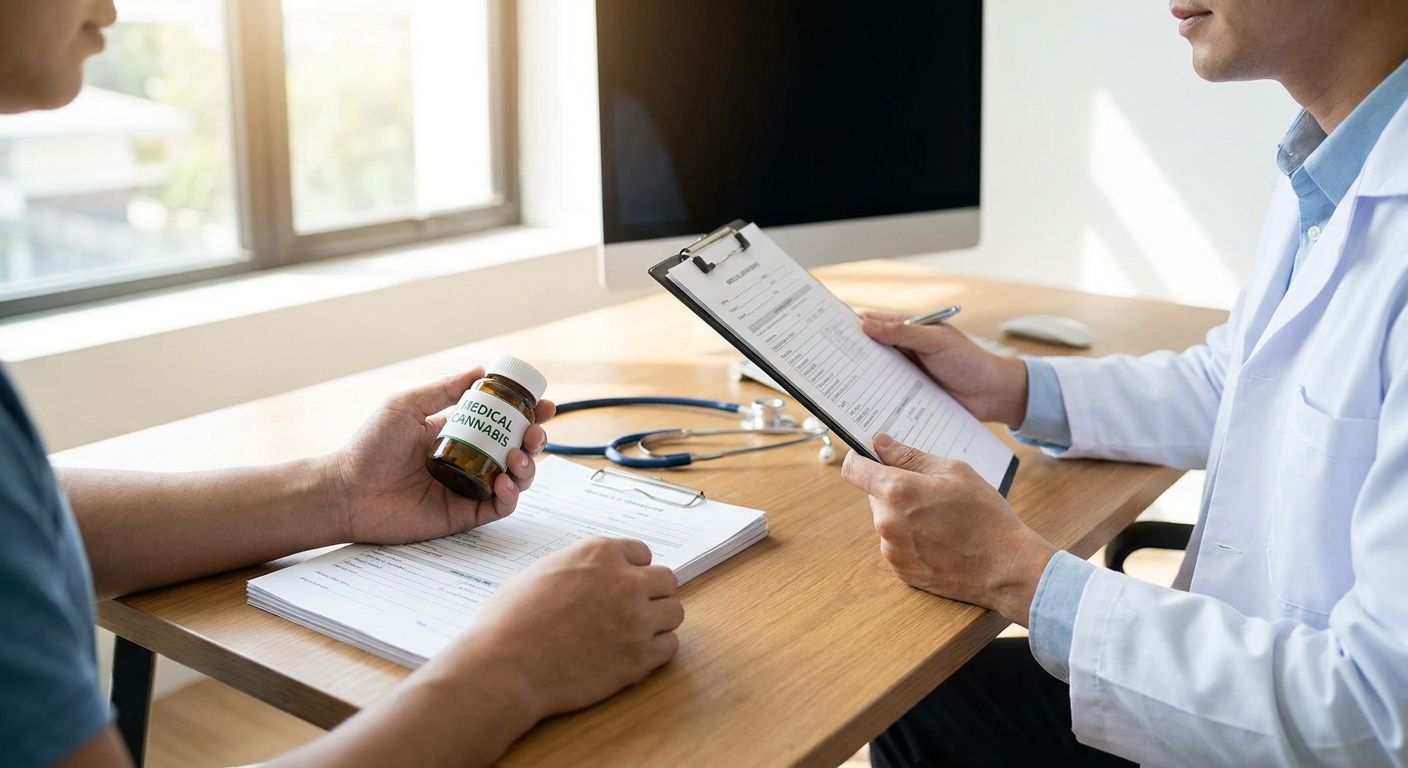
Immigration medical exam medical marijuana questions come up constantly for green card applicants who hold a state medical marijuana card or use marijuana under a doctor's recommendation. Medical marijuana use does not automatically disqualify you from Form I-693, but the civil surgeon must document it accurately under federal standards, not state law. This guide explains what the exam actually covers, what to bring, and where applicants in this situation commonly run into delays.
- Immigration medical exam medical marijuana questions focus on whether you have a diagnosable substance-related disorder, not on state legality.
- Civil surgeons assess marijuana use under CDC's Technical Instructions, not state medical marijuana laws.
- Honest disclosure during your health history intake keeps your Form I-693 accurate and avoids delays.
- State medical marijuana cards don't exempt you from federal evaluation because marijuana stays Schedule I federally in 2026.
- Bring documentation of any diagnosed condition and be ready to answer questions about your marijuana use.
Why this matters for applicants who use medical marijuana
More than half of U.S. states allow medical marijuana in some form, but immigration law is federal, and marijuana remains a Schedule I controlled substance under federal law in 2026 regardless of your state's rules. That gap creates real confusion. Applicants assume a state card settles the question during their pre-screening health history, then get surprised when the civil surgeon asks follow-up questions anyway.
USCIS-designated civil surgeons follow CDC's Technical Instructions for Civil Surgeons when completing Form I-693. Those instructions require an assessment for substance-related disorders and any harmful behavior connected to drug use, separate from whether the substance is legal in your state. The exam is not designed to punish marijuana use on its own — it's designed to identify a diagnosable disorder, if one exists, and document it correctly.
Getting this part of the exam right the first time matters more than most sections of Form I-693, because an incomplete or inconsistent health history is one of the more common reasons an application gets flagged for additional review.
How to prepare for your immigration medical exam if you use medical marijuana
Understand how USCIS evaluates substance use
Before your appointment, know the difference between casual disclosure and a diagnosable condition. The civil surgeon is looking for specific things, not making a judgment call on legality.
- Marijuana remains a federally controlled substance in 2026, independent of any state medical marijuana program.
- Civil surgeons assess for a substance-related disorder using DSM-5 criteria, referenced in CDC's Technical Instructions.
- "Harmful behavior" tied to drug use is evaluated separately from occasional or prescribed use.
- A state medical marijuana card does not automatically indicate a disorder — it's one piece of your history, not a diagnosis.
- The civil surgeon documents findings on Form I-693; your immigration attorney is the right resource for how a finding affects your specific case.
Complete your pre-screening health history honestly
Most delays in this category come from incomplete forms, not from marijuana use itself. Fill out your intake paperwork the same way you'd answer a doctor at any appointment.
- Disclose marijuana use even if it feels unrelated to your reason for the visit.
- Note frequency and purpose (recreational versus a doctor-recommended treatment) if asked.
- List any other medications or substances you use regularly.
- Avoid guessing on dates or amounts — approximate honestly rather than omitting the answer.
- A telehealth pre-screening before your in-person visit lets you get these questions right before the exam day, which is faster than sorting it out at the front desk.
Gather supporting documentation before your appointment
Documentation speeds up your visit and gives the civil surgeon accurate information to work with.
- Your state medical marijuana card or physician recommendation, if you have one.
- A diagnosis letter from a treating physician, if marijuana was recommended for a specific condition.
- A current medication list, including dosages.
- Any prior lab work or evaluations related to substance use, if applicable.
- Your existing vaccination records — review the USCIS vaccination requirements so you're not missing this piece too.
Know what happens during the civil surgeon exam itself
The visit follows a set structure whether or not marijuana use is part of your history.
- A physical exam and review of your full health history.
- Standard tuberculosis testing as required for your age group.
- Direct questions about substance use if your history or documentation raises them.
- Additional follow-up questions only when your answers suggest a possible disorder — not as a routine step for every applicant.
Choose a clinic experienced with this specific situation
A general primary care office or urgent-care clinic may not see immigration cases often enough to handle marijuana-related history smoothly. ImmigrationMedicalExams.com has focused exclusively on Form I-693 exams since 2007, and civil surgeons there have handled this exact scenario many times. The clinic offers transparent package pricing, standard completion in 3 business days, and a 2-business-day expedited option when your scheduling, lab results, and documentation line up. Same-day appointments may be available, and booking is open online 24 hours a day.
Schedule your immigration medical exam
Book online any time with a civil surgeon experienced in these cases.
Keep your sealed Form I-693 secure until filing
Once your exam is complete, the civil surgeon seals your Form I-693 for submission.
- Never open the sealed envelope yourself.
- Confirm with your attorney whether you're filing by mail or through online filing.
- Submit the form within the timeframe USCIS specifies for your case type.
- Keep a copy of your appointment confirmation and receipt for your own records.
Comparing your options for this exam
| Option | Best for | Key limitation | Verdict |
|---|---|---|---|
| Dedicated immigration medical exam clinic | Applicants who want a civil surgeon familiar with substance-history questions | Fewer locations than general practices | Recommended |
| General primary care doctor | Applicants who already have an established relationship with that doctor | May not perform civil surgeon exams regularly, and I-693 errors are common | Consider with caution |
| Urgent-care clinic | Applicants who need any appointment quickly with no other option | Often unfamiliar with I-693 documentation standards for substance history | Skip if avoidable |
| Telehealth-only pre-screening service | Applicants preparing their health history before an in-person visit | Cannot complete the physical exam or Form I-693 on its own | Use as a first step, not a substitute |
Common mistakes applicants with medical marijuana use make
- Assuming a state medical marijuana card settles the question. It doesn't — federal review still applies in 2026.
- Hiding marijuana use from the civil surgeon. Inconsistent answers between your intake form and your exam raise more questions than honest disclosure does.
- Skipping documentation of a legitimate diagnosis. A diagnosis letter can clarify context that a bare admission of use cannot.
- Confusing occasional use with a diagnosable disorder. These are evaluated differently, and conflating them creates unnecessary worry.
- Waiting until close to a filing deadline to address a complicated history. Complex cases benefit from extra time, not less.
FAQ
Does using medical marijuana affect my immigration medical exam?
It can be part of your health history review, but use alone does not automatically create a problem. The civil surgeon documents whether you have a diagnosable substance-related disorder, following CDC's Technical Instructions for Civil Surgeons.
Will USCIS deny my green card because I have a medical marijuana card?
Having a state medical marijuana card is not, by itself, a reason for denial. Outcomes depend on your individual history and documentation, so this is a question to review with an immigration attorney.
Do I have to tell the civil surgeon about my marijuana use?
Yes. Your health history intake should reflect your actual history, since inconsistent or incomplete answers can slow down completion of Form I-693.
Does state legalization change federal immigration medical requirements in 2026?
No. Marijuana remains a Schedule I controlled substance under federal law in 2026, and federal standards govern the immigration medical exam regardless of state law.
What is a substance-related disorder on Form I-693?
It's a diagnosis the civil surgeon may document based on DSM-5 criteria referenced in CDC's Technical Instructions, separate from simply disclosing occasional or prescribed use.
Can I bring my medical marijuana recommendation to my exam?
Yes, bringing your card or physician recommendation along with any diagnosis letter gives the civil surgeon accurate context for your health history.
Does a positive drug test automatically fail my immigration medical exam?
A test result on its own is not an automatic outcome. The civil surgeon evaluates it alongside your full history, and specific case outcomes depend on your individual circumstances.
How long does the immigration medical exam take if I disclose marijuana use?
Standard completion is typically 3 business days, with a 2-business-day expedited option when scheduling, lab results, and documentation allow. Additional questions during your visit may add time to the appointment itself, not necessarily the overall turnaround.
One last thing
The detail applicants overlook most: a diagnosis letter from your own physician, if marijuana was recommended for a real medical condition, often resolves more questions in five minutes than an hour of back-and-forth without it. Bring the paperwork, answer directly, and let the civil surgeon do the documentation correctly the first time.