3-Day I-693 Processing in Southern California Clinics
When people search for “I-693 processing time,” they usually mean the clinic side of things: how long it takes a civil surgeon to complete, sign, and seal Form I-693. At Immigrationmedicalexams, standard processing runs about 3 business days, with a 2-business-day expedited option. This is separate from how long USCIS takes to review your application after it arrives.
TL;DR:
- Completing the I-693 form in one visit is possible if the clinic processes tests and vaccinations on-site and the applicant has complete records.
- External labs, referrals for imaging, or missing vaccination documentation can extend processing from days to several weeks.
- Choosing IGRA blood tests over skin tests for TB can eliminate the need for a return visit, speeding up the overall timeline.
- Booking appointments well in advance, ideally 2 to 6 weeks before USCIS deadlines, helps accommodate potential delays like retesting or referrals.
- Clinics specializing exclusively in immigration exams, like Immigrationmedicalexams, typically deliver sealed I-693 forms in 3 business days, with expedited options available.
Table of Contents
- What Affects Your Clinic’s I-693 Turnaround Time
- How Long Does Each Timeline Scenario Actually Take?
- How Can You Speed Up Your I-693 Appointment?
- What Should You Bring, and What Happens During the Visit?
- Does Processing Time Vary by USCIS Office or Region?
- How Do You Schedule an Appointment and What Are Typical Wait Times?
- How Long Is Form I-693 Valid Once It’s Signed?
- What Causes Delays That Have Nothing to Do With the Clinic?
- Could COVID-19 or Other External Events Still Slow Things Down?
- How Immigrationmedicalexams Delivers Fast, Predictable I-693 Turnaround
- Clinic Perspective: What Actually Slows Applicants Down
- Sources
- FAQ
What Affects Your Clinic’s I-693 Turnaround Time
The 3-day standard timeline assumes a fairly clean case. Several variables can shrink that window to a single visit or stretch it out over a couple of weeks, and most of them come down to logistics rather than anything medically complicated.
Lab location matters more than people expect. Clinics that draw blood and run tests on-site typically finalize results faster than clinics that ship specimens to an outside lab. External labs add courier time, batching delays, and sometimes a second visit just to review results before the surgeon can sign off.
TB testing method is the single biggest timing lever. CDC tuberculosis guidance for civil surgeons confirms that an IGRA blood test avoids the mandatory 48 to 72 hour return visit required for a TST skin test reading. Choosing IGRA when it’s clinically appropriate is often the difference between sealing your I-693 in one visit versus scheduling a second appointment days later.
Chest X-rays add a step when referred externally. If your clinic doesn’t have imaging in-house and TB screening triggers a chest X-ray, you’re now coordinating a separate appointment and waiting for a radiology report to come back before the surgeon can complete the form.
Vaccination records decide whether you leave with a completed form or a homework assignment. Missing or unclear vaccination history usually means one of two paths: catch-up vaccines given per CDC vaccination technical instructions, or serologic titer testing to confirm existing immunity. Both routes work, but neither is instant.
Factors that most commonly extend clinic turnaround:
- Skin test (TST) instead of blood test (IGRA) for TB screening
- External lab or imaging referrals instead of on-site services
- Incomplete or unavailable vaccination records
- A suspected Class A or Class B condition requiring specialist evaluation before final clearance
- Missing prior medical records that force the surgeon to order duplicate testing
Clinics that handle labs, vaccines, and imaging in-house tend to produce far more predictable timelines, since there’s no external dependency holding up the final signature.
How Long Does Each Timeline Scenario Actually Take?
Not every applicant experiences the same 3-day window. Your actual timeline depends heavily on which of the factors above apply to your case.
Best case: You have complete vaccination records, no TB or medical history complications, and your clinic handles labs and imaging on-site. In this scenario, an I-693 can be signed, completed, and sealed in 1 to 2 business days.
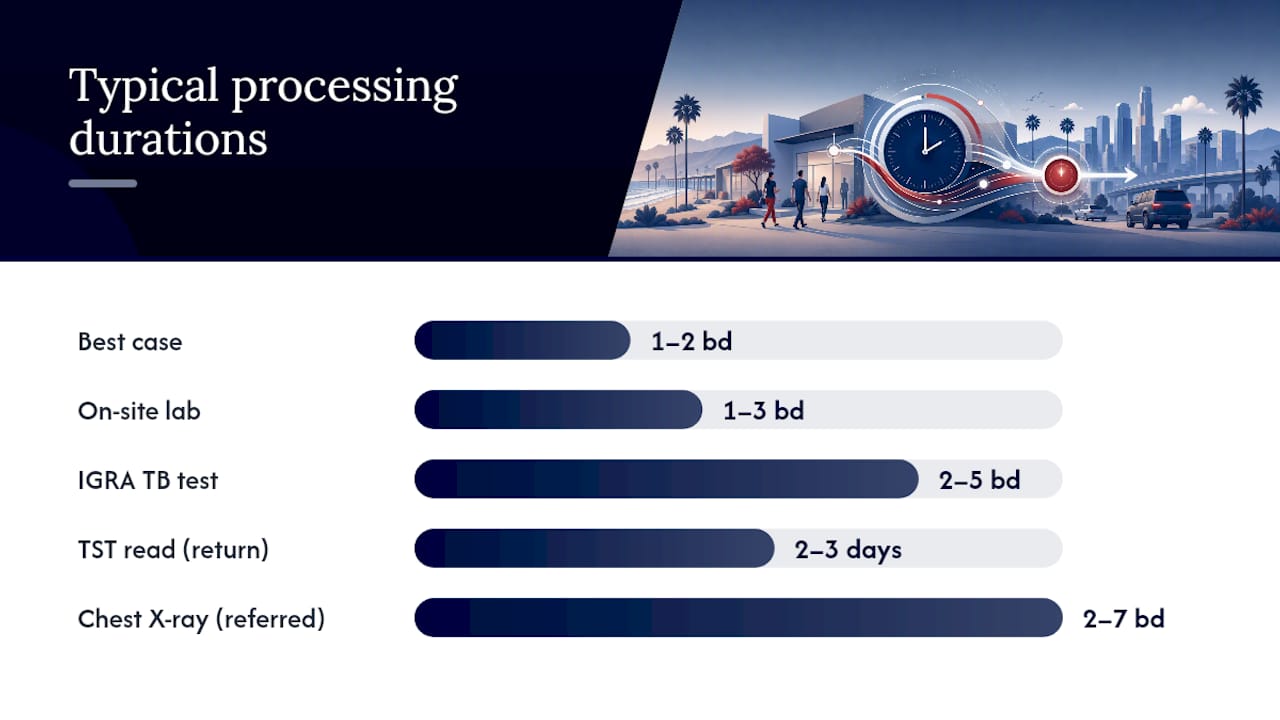
Typical case: You need standard bloodwork and an IGRA TB test, both processed on-site or through a fast local lab. Clinic timeline data suggests IGRA results commonly return in 2 to 5 business days, with routine bloodwork often back in 1 to 3 business days. This is the range most applicants fall into, and it lines up closely with Immigrationmedicalexams’ 3-day standard processing.
Complicated case: You need a TST read (adding a mandatory 48 to 72 hour return visit), your imaging gets referred out, or you need catch-up vaccinations or serologic testing. These cases can stretch to 1 to 3 weeks or more, particularly when multiple factors stack together.
| Stage | Typical duration |
|---|---|
| Scheduling the appointment | Same day to a few days |
| Physical exam and initial visit | 1 visit, roughly one hour |
| On-site lab processing | 1 to 3 business days |
| IGRA TB blood test results | 2 to 5 business days |
| TST skin test reading (if used) | 48 to 72 hours, separate visit required |
| Chest X-ray (if referred externally) | 2 to 7 business days |
| Final review and sealing of Form I-693 | Same day once all results are in |
The gap between best case and complicated case isn’t random. It’s almost entirely explained by testing choices and whether services stay in-house.
How Can You Speed Up Your I-693 Appointment?
Most delays are avoidable with a little preparation before you ever sit down with a civil surgeon. Here’s the sequence that actually moves the needle:
- Download and complete Part 1 of Form I-693, but don’t sign it. USCIS instructs applicants to fill out their portion ahead of time and wait to sign until the civil surgeon tells them to.
- Bring a government-issued photo ID and your original vaccination records, not photocopies if you can help it.
- Ask about IGRA availability before you book. A clinic that offers blood-based TB testing on-site can often save you an entire return visit.
- Bring prior chest X-ray films or reports and TB test history. Duplicate testing is one of the most common (and most avoidable) causes of delay.
- Request a photocopy of your completed I-693 before it goes into the sealed envelope. This doesn’t violate the sealed-envelope rule and gives you a personal record in case anything gets lost in the mail.
- Build in a scheduling buffer. A window of 2 to 6 weeks before your planned I-485 filing or interview gives you room to absorb a TST read, a referral, or a catch-up vaccine series without jeopardizing your filing date.
Pro Tip: If you’re not sure whether you’re a candidate for catch-up vaccines versus titer testing, ask before your appointment. Clinics that know your vaccination gaps in advance can often resolve them the same day instead of sending you home to gather more records.
What Should You Bring, and What Happens During the Visit?
Walking in prepared is the single biggest factor in whether you leave with a sealed form or a to-do list. Bring the following:
- Your completed (but unsigned) Part 1 of Form I-693
- A government-issued photo ID
- Original vaccination records, including childhood immunizations if available
- Any prior lab results, chest X-ray reports, or TB test history
During the visit, expect a physical exam, a lab draw for standard bloodwork, and a decision on your TB test method. If vaccines are needed and appropriate for same-day administration, most clinics handle that on the spot. A chest X-ray happens if your TB screening or medical history indicates one is necessary.
Once every result is back and reviewed, the civil surgeon completes, signs, and seals Form I-693 Immigration Medical Exam: What to Expect. USCIS requires that sealed envelope to stay intact until you submit it. If you’re filing Form I-485 online, you’ll need to open that sealed envelope yourself to upload the completed form exactly as USCIS instructs. Keep that in mind. It surprises a lot of applicants who assume “sealed” means “never opened.”
Does Processing Time Vary by USCIS Office or Region?
The clinic side of your I-693 timeline doesn’t change based on which USCIS field office or service center will eventually receive your application. A civil surgeon in Costa Mesa follows the same federal guidelines as one in Chicago or Miami, and the exam requirements, sealed-envelope rule, and Form I-693 instructions are identical nationwide.
What does vary regionally is clinic capacity and appointment availability. Southern California counties, including Los Angeles, Orange, Riverside, and San Bernardino, have a dense population of adjustment-of-status applicants competing for civil surgeon appointments, particularly around USCIS filing deadlines or interview notice periods. That competition for slots, not any regional difference in the exam itself, is usually what stretches out the timeline for applicants who wait too long to book.
Some regions also have fewer clinics offering true on-site labs and imaging, which pushes more applicants toward the external-referral path described earlier. If you’re comparing wait times between two clinics in the same area, the difference usually comes down to whether they process everything in-house or send work out.
The bottom line: the form itself and the federal rules governing it are uniform everywhere in the country. Your actual wait time depends on the specific clinic you choose, not on which USCIS office will eventually process your case.
How Do You Schedule an Appointment and What Are Typical Wait Times?
Booking a civil surgeon appointment in Southern California typically works one of two ways: a phone call during business hours or an online scheduling system available around the clock. Clinics that offer 24/7 online booking tend to fill slots faster simply because applicants can grab an opening the moment they decide to move forward, rather than waiting for office hours.
Wait times for an initial appointment usually range from same-day to about a week out, depending on the clinic’s capacity and the time of year. Demand spikes around common filing seasons, so booking a few weeks ahead of when you actually need the exam gives you more flexibility to pick a convenient time slot rather than taking whatever is left.
It’s worth asking, when you book, whether the appointment covers the full exam in one visit or whether you should expect a follow-up. A clinic that handles labs, vaccines, and TB testing on-site in a single appointment is a meaningfully different experience than one that requires you to return two or three times before your form is complete.
If your case involves anything unusual, like uncertain vaccination history or a prior TB diagnosis, mention it when you schedule. A clinic that knows your situation ahead of time can often prepare the right testing protocol before you arrive, which shortens your total visit count.
How Long Is Form I-693 Valid Once It’s Signed?
Form I-693 doesn’t stay valid indefinitely once the civil surgeon seals it. USCIS updates its validity policy periodically, and the USCIS Policy Manual is the authoritative source for the current validity window. Because that guidance can change, it’s worth confirming the current rule directly with USCIS or your immigration attorney before you finalize your filing date.
This is exactly why the scheduling buffer matters. If you complete your exam too early relative to your I-485 filing or your interview date, you risk needing a brand-new I-693 simply because too much time passed. If you wait too long, you risk not having a completed form ready when USCIS needs it.
The safest approach is to time your civil surgeon appointment as close as reasonably possible to your actual filing or interview date, while still leaving enough of a buffer, generally 2 to 6 weeks, to absorb any TB retesting, catch-up vaccines, or specialist referrals without missing your window. Ask your civil surgeon’s office directly about current validity rules for your specific situation. They deal with this timing question daily and can flag anything that puts your form at risk of expiring before you use it.
What Causes Delays That Have Nothing to Do With the Clinic?
Not every delay traces back to lab results or TB testing. Some of the most frustrating holdups happen after your sealed envelope leaves the exam room.
Incomplete Part 1 paperwork is a common one. If you didn’t fill out your portion of the form correctly, or you signed it before the civil surgeon told you to, that error can force a redo of the entire form, even if every medical result is fine.
Additional review for suspected Class A or Class B conditions pauses the process by design. If a civil surgeon identifies a condition of public health significance, the case may require a specialist evaluation before final clearance, and that referral timeline sits entirely outside the clinic’s control.
Prior exams performed elsewhere with errors or omissions are one of the most common issues applicants bring to Immigrationmedicalexams. A form filled out incorrectly, a missing vaccine, or a TB test that wasn’t documented properly can mean starting significant parts of the process over, even though the applicant already paid for and sat through an exam once.
Lost or damaged sealed envelopes during mailing or in-person submission also cause real delays, which is part of why requesting a personal photocopy before sealing is worth doing every time. Read more about the sealed envelope requirement and why that rule exists in the first place.
None of these delays are about how fast the clinic works. They’re about paperwork accuracy and downstream handling, which is exactly why preparation before your appointment matters as much as the appointment itself.
Could COVID-19 or Other External Events Still Slow Things Down?
Appointment availability and lab capacity both took real hits during the height of the pandemic, and that experience left a lasting lesson: external disruptions, whether public health emergencies, severe weather, or lab supply shortages, can affect wait times even when a clinic’s internal process hasn’t changed at all.
Today, most Southern California clinics have returned to normal scheduling capacity, but the underlying vulnerability hasn’t disappeared. A regional lab outage, a spike in flu or respiratory illness straining walk-in demand, or a supply shortage affecting vaccine availability can still create short-term bottlenecks. These events tend to show up as longer appointment wait times rather than longer in-clinic processing once you’re actually being seen.
The practical takeaway is the same one that applies to every other risk in this article: build in a buffer. If you’re scheduling your exam months in advance, you’re insulated from most short-term disruptions. If you’re trying to book two weeks before a filing deadline during a period of unusual demand, an external event, even a minor one, has a lot less room to absorb before it affects your timeline.
Clinics that maintain in-house lab and vaccine capability tend to weather these disruptions better than those relying on outside labs and referral networks, simply because they have fewer points of failure outside their own walls.
How Immigrationmedicalexams Delivers Fast, Predictable I-693 Turnaround
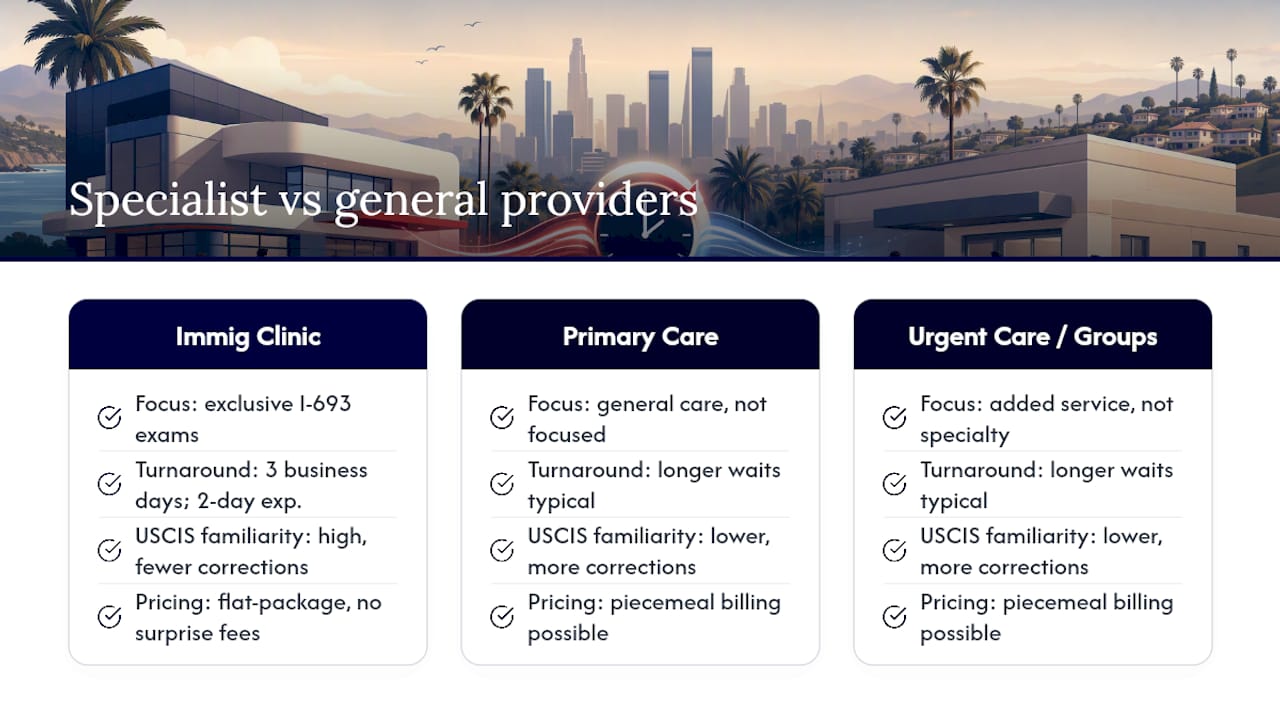
There are other paths to a completed I-693: primary care doctors who occasionally take on civil surgeon work, urgent care clinics that added the service as a side offering, or larger medical groups where immigration exams are one of dozens of things they handle. The tradeoff with all of them is the same: immigration exams aren’t their focus, and that shows up as longer waits, less familiarity with USCIS requirements, and more corrections needed later.
Immigrationmedicalexams has specialized exclusively in immigration medical exams and Form I-693 since 2007. No primary care, no urgent care, no sick visits, just the exam, the labs, the vaccines, and the form. Standard processing takes about 3 business days and includes on-site lab draws, vaccination review and administration when appropriate, and a completed, sealed I-693. Need it faster? The 2-business-day expedited option covers the same scope on a tighter timeline.

The clinic runs on flat-package pricing designed to avoid the surprise charges that come with piecemeal billing at general practices, and you can view current pricing details before you book. A large share of the applicants who come through the door have already had an exam somewhere else that came back incomplete, incorrectly filled out, or missing vaccination documentation, and getting it right the first time is the entire point of specializing this narrowly.
Booking is available through 24/7 online scheduling, so you’re not stuck waiting for office hours to grab a slot. Once you book, you’ll get instructions on what to bring, including your unsigned Part 1 and any prior records. Immigrationmedicalexams serves applicants across Los Angeles, Orange, Riverside, and San Bernardino counties. Check current appointment availability and get your I-693 timeline locked in before your filing window gets tight.
Clinic Perspective: What Actually Slows Applicants Down
Most delays we see aren’t medical. They’re avoidable. Applicants show up without vaccination records, choose a skin test without realizing it means a second visit, or accept an unsealed I-693 from a previous provider without knowing that’s a problem.
On-site labs and a clinic that communicates clearly with you before the appointment fix most of this. When we know your history in advance, we can often finish in one visit instead of three. Standard processing runs about 3 business days, expedited is 2. Book with a buffer, and don’t sign anything until we tell you to.
— ImmigrationMedicalExams Medical Team
Sources
FAQ
What Does “I-693 Processing Time” Actually Mean?
It refers to how long the civil surgeon’s clinic takes to complete, sign, and seal your Form I-693, not how long USCIS takes to review your application afterward.
How Long Does Immigrationmedicalexams Take to Complete an I-693?
Standard processing takes about 3 business days, with a 2-business-day expedited option available for applicants on a tighter timeline.
Why Would My I-693 Take Longer Than a Few Days?
A TST skin test requiring a 48 to 72 hour return visit, external lab or imaging referrals, incomplete vaccination records, or a suspected Class A or Class B condition needing specialist review are the most common causes.
Can I Get a Copy of My I-693 Before It’s Sealed?
Yes. Requesting a photocopy before the civil surgeon seals the envelope is a practical way to keep a personal record without violating USCIS’s sealed-envelope rule.
How Far in Advance Should I Schedule My Exam Before Filing?
A window of 2 to 6 weeks before your planned I-485 filing or interview is generally recommended, giving you room to handle any TB retesting or catch-up vaccines without missing your deadline.