
3 Day I-693 for Children: Pediatric Checklist and Sealed Form Service

Most children filing Form I-485 must submit a Form I-693 completed and signed by a USCIS-designated civil surgeon, covering a physical exam, TB screening, and required vaccinations. A handful of exceptions apply, including adoption affidavits and prior overseas exams. Start by pulling together your child’s birth certificate and vaccination history, then book a civil-surgeon appointment before you file.
TL;DR:
- Most children filing Form I-485 must submit a completed and sealed Form I-693 signed by a civil surgeon, ideally with the appointment booked before filing to avoid delays.
- Children aged 2 and older require specific TB blood tests, and missing vaccination records often lead to additional visits or delays if documentation is incomplete.
- Adopted children under 10 can use an affidavit exception instead of full vaccine completion at the time of exam, speeding up the process.
- Civil surgeons often accept prior overseas exam results or partial vaccination histories, reducing the need for repeated tests or shots.
- Costs and processing times vary based on required vaccines and tests, with most clinics offering same-day or expedited options to meet USCIS deadlines.
Table of Contents
- Who Needs Form I-693 for Children?
- What Happens During a Child’s Immigration Medical Exam?
- How Should You Prepare Your Child for the Civil-Surgeon Visit?
- What Exceptions Exist for Adopted or Internationally Examined Children?
- What Happens After the Exam: Sealing, Submitting, and Validity
- What Do Fees and Timelines Actually Look Like?
- How ImmigrationMedicalExams.com Supports Children’s I-693 Exams
- Clinical Perspective: What Civil Surgeons Wish Parents Knew
- Booking Your Child’s I-693 Exam With ImmigrationMedicalExams
- Sources
- FAQ
Who Needs Form I-693 for Children?
If your child is filing Form I-485 to adjust status, they almost certainly need a completed Form I-693 signed by a civil surgeon. USCIS treats the medical exam as a required piece of the adjustment package for nearly every age group, from infants to teenagers, with a few notable carve-outs.
Some categories work a little differently:
- Adopted children age 10 or younger may qualify for an affidavit exception instead of completing every vaccine before filing, discussed in detail later in this guide.
- K-visa holders typically already completed a medical exam overseas with a panel physician, and parts of that exam may carry over.
- Refugees and asylees adjusting status sometimes have an earlier medical screening on file that reduces what the civil surgeon needs to repeat.
- Children with a prior overseas panel-physician exam may only need a partial I-693 focused on updated vaccinations rather than a full physical and lab workup.
On timing, USCIS has tightened expectations in recent years, generally requiring Form I-693 to be submitted along with Form I-485 rather than added later in the process. That shift means scheduling the civil-surgeon appointment early, ideally in the weeks before you file, not after a request for evidence forces your hand. Waiting until USCIS asks for it almost always costs families more time than booking it up front.
What Happens During a Child’s Immigration Medical Exam?
The civil surgeon exam for a child looks different from an adult version, mostly because of age-based rules on testing and vaccines. Here’s what actually happens in the room.
The physical exam and history. The civil surgeon reviews the child’s medical history, checks growth and development where relevant, and documents findings directly on Form I-693 Immigration Medical Exam: What to Expect. For younger children, this is usually quick and centered on general health rather than detailed screening.
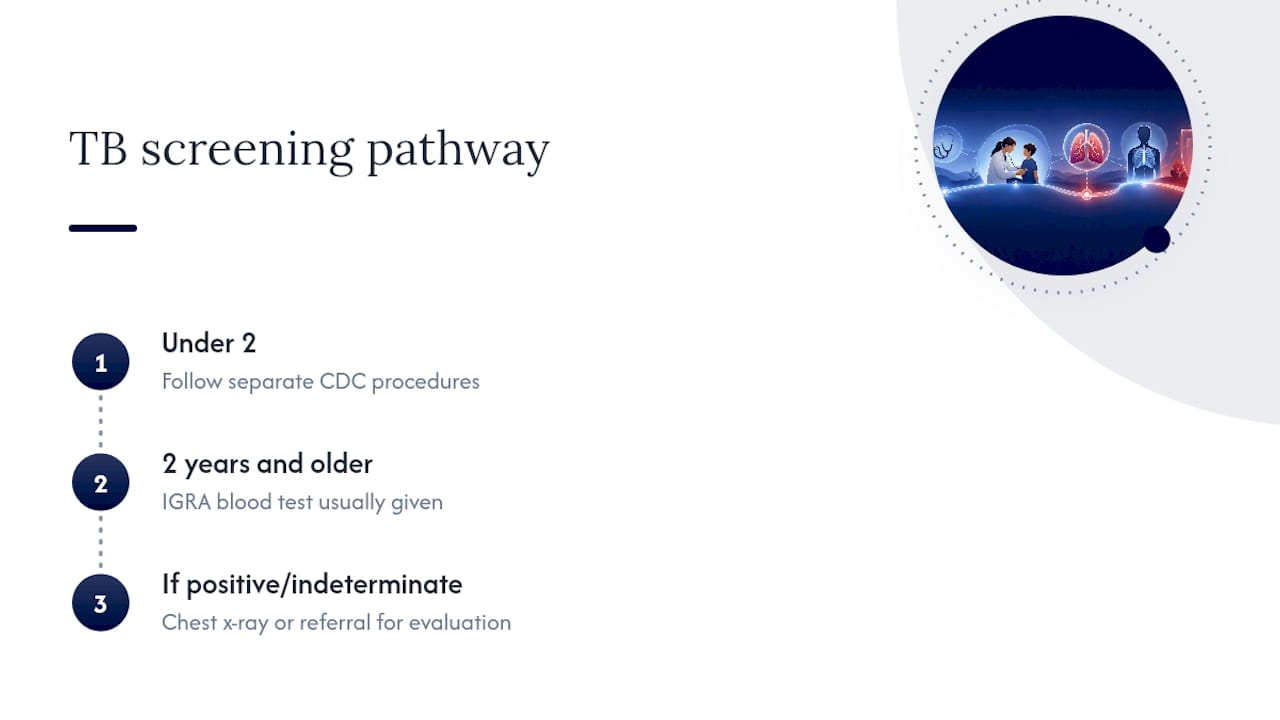
Tuberculosis screening. Children 2 years and older require an IGRA blood test for TB screening, replacing the older skin-test approach for most applicants. Children under 2 follow separate CDC procedures, since IGRA testing is less reliable at that age. A positive or indeterminate result can trigger a chest x-ray or a referral for further evaluation, so don’t panic if your civil surgeon orders a follow-up test. It’s a normal part of the protocol, not a sign something is wrong.
Lab tests by age. Younger children generally skip syphilis and gonorrhea testing unless there’s a specific risk indicator; those tests apply more consistently to adolescents and adults. Your civil surgeon determines what’s age-appropriate based on CDC’s Technical Instructions.
Vaccinations. This is usually where families spend the most time. CDC’s vaccination Technical Instructions map required vaccines to specific age brackets, and civil surgeons must document your child’s history, administer anything missing, and note when a full series can’t realistically be finished before the exam. If your child needs three more doses of a series spread over months, the civil surgeon can record that at least one age-appropriate dose was given and outline a follow-up schedule instead of holding up the entire application.
One update worth knowing: as of May 1, 2024, CDC’s polio vaccination instructions call for one dose of IPV in anyone 2 months or older who isn’t already up to date. If your child’s exam happens after that date, expect the civil surgeon to check polio status closely.
Pro Tip: Bring your child’s pediatrician immunization printout, even an incomplete one. Civil surgeons can often accept documented prior doses instead of restarting a series from scratch, which saves your child unnecessary shots.
Vaccination gaps are one of the most common reasons families end up needing a second appointment, since a civil surgeon can’t sign off on a series they have no record of.
How Should You Prepare Your Child for the Civil-Surgeon Visit?
A little preparation before the appointment prevents most of the back-and-forth that delays a case. Here’s the order that works best:
- Gather identity documents. Bring the child’s birth certificate, with an English translation if it’s issued in another language, plus a passport if available.
- Collect vaccination records. Pull whatever your pediatrician has on file, even partial records; the civil surgeon needs dates, not just a list of vaccine names.
- Bring parent identification. The accompanying parent or guardian should bring a government-issued photo ID.
- Bring prior immigration medical paperwork. If the child had an overseas panel-physician exam, bring copies for the civil surgeon to review.
- Confirm the appointment covers vaccine administration. Ask ahead whether the office can administer missing vaccines the same day, so you’re not scheduling a second visit.
On identification specifically, USCIS does not require a government-issued photo ID for children 14 or younger. A birth certificate works, and if that’s unavailable, an affidavit stating the child’s name, date and place of birth, and the parent’s full name is an acceptable substitute.
If your child has a medical contraindication to a required vaccine, say a documented allergy or an immune condition, the civil surgeon can note that on the form instead of forcing an unsafe vaccination. This still requires the civil surgeon to document the specific medical reason, not just a parent’s preference.
Pro Tip: Call ahead and ask if the clinic keeps vaccines in stock for children. Some offices only administer adult formulations, and a missing pediatric dose on appointment day means starting the paperwork over.
What Exceptions Exist for Adopted or Internationally Examined Children?
A few scenarios change what your child needs, and knowing which one applies can save weeks of back-and-forth with USCIS.
- Adopted children age 10 or younger can qualify for an affidavit exception under the USCIS Policy Manual. The adoptive parent signs an affidavit agreeing to vaccinate the child within 30 days of admission to the United States, which means the child isn’t classified as having a Class A medical condition just for missing shots at the time of the exam. This option lets families move forward with an adoption without waiting on a full vaccine catch-up schedule first.
- Children with a prior panel-physician exam abroad sometimes only need a partial I-693 focused on vaccination status, since the physical exam and TB screening may already be on file from the overseas process.
- Medically appropriate waivers apply when a specific vaccine isn’t safe or effective for a child’s situation, documented by the civil surgeon rather than granted automatically. This isn’t a blanket exemption; it’s a case-by-case medical determination tied to the individual child.
Attorneys handling adoption cases often flag the affidavit exception as underused, since it lets families bring a child in sooner rather than delaying travel to finish a vaccine series overseas.
What Happens After the Exam: Sealing, Submitting, and Validity
Once the civil surgeon finishes the exam, Form I-693 goes into a sealed envelope, and that seal matters more than most parents expect.
- Never accept or submit an opened envelope. USCIS explicitly requires the completed I-693 to be sealed by the civil surgeon before it’s handed to you, and an opened or tampered envelope is a common trigger for USCIS to reject the submission and ask for a new exam.
- Paper filers include the sealed envelope with the rest of the Form I-485 package, unopened.
- Online filers typically need to upload a scan of the form as instructed, while still keeping the sealed original in case USCIS requests it later.
- Keep a copy before sealing, if possible. Ask the civil surgeon whether you can get a photocopy of the completed form for your own records before it goes into the sealed envelope, since that gives you a reference if USCIS later asks questions.
On validity, USCIS periodically updates how long a completed I-693 remains acceptable, and delays in filing after the exam can trigger a request for an updated version. If your child’s application sits for months after the exam, check current guidance before assuming the original form still qualifies.
What Do Fees and Timelines Actually Look Like?
Costs vary by clinic and by what your child’s exam includes. A straightforward exam with no missing vaccines costs less than one requiring several catch-up doses, extra lab work, or same-day expedited processing.
Expect two general paths: standard processing, which most clinics complete within a few business days, and expedited processing for families on a tighter USCIS deadline. Realistic scheduling means booking the appointment at least a week or two before you plan to file, so there’s room to handle any follow-up requirements.
The most common pitfalls that delay a child’s case:
- Incomplete vaccine documentation the civil surgeon can’t verify, forcing a restart of the series.
- An opened or damaged sealed envelope, which USCIS treats as grounds to request a new exam entirely.
- Missing English translations for foreign-language birth certificates or prior medical records.
- Wrong sections completed on the form, especially confusing a full exam with a partial vaccination-only version.
Pro Tip: If your child had any medical care overseas within the past year, bring those records even if you’re not sure they’re relevant. Civil surgeons would rather have too much documentation than have to guess.
How ImmigrationMedicalExams.com Supports Children’s I-693 Exams
Since 2007, Immigrationmedicalexams has focused exclusively on immigration medical exams, not primary care or urgent care visits, which means every appointment is built around getting Form I-693 right rather than squeezed between unrelated patient needs.
For families dealing with a child’s exam, a few things matter in practice:
- A flat-package pricing approach designed to avoid surprise charges when a child needs extra vaccine doses or lab work.
- On-site lab testing and vaccine administration, so most children finish everything in a single visit instead of bouncing between offices.
- Standard turnaround around 3 days, with a 2-day expedited option for families racing a filing deadline.
- Sealed-form handling that follows USCIS requirements precisely, reducing the chance of a rejected envelope.
- An Attorney Resource Center for families working with immigration counsel who need documentation aligned with a specific case strategy.
The clinic regularly works with families correcting problems from exams performed elsewhere, including missing vaccine rows and improperly handled sealed forms.
Clinical Perspective: What Civil Surgeons Wish Parents Knew
Exam pacing changes a lot by age. Infants and toddlers need a calmer, faster approach with minimal handling, while school-age kids often do better when a parent explains each step in advance rather than surprising them at the appointment.
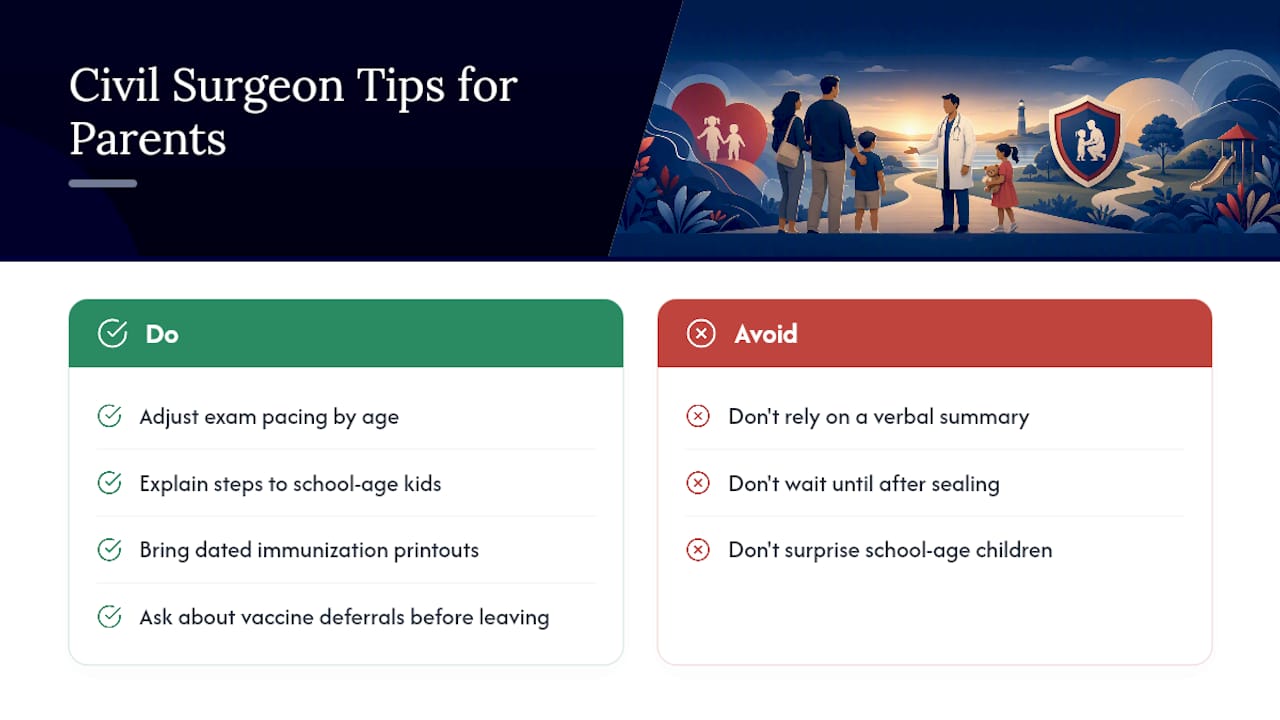
The biggest practical friction point isn’t the exam itself. It’s mismatched vaccine records between what a pediatrician has on file and what the civil surgeon can accept on Form I-693. Bringing dated immunization printouts, not just a verbal summary, resolves most of that friction before it becomes a delay.
One habit worth building: ask the civil surgeon directly whether any vaccine can be deferred for medical reasons before the appointment ends, rather than after the sealed form is already in hand.
— ImmigrationMedicalExams Medical Team
Booking Your Child’s I-693 Exam With ImmigrationMedicalExams
Families juggling a child’s adjustment-of-status paperwork don’t need extra complexity added to an already detailed process. Immigrationmedicalexams handles immigration medical exams exclusively, which means the appointment is built entirely around finishing Form I-693 correctly, not squeezed between other kinds of visits.

The clinic’s flat-package pricing covers the civil-surgeon exam, on-site lab testing, and vaccine administration in one visit for most children, with standard processing around 3 days and a 2-day expedited option for families working against a filing deadline. Every completed form follows USCIS’s sealed-envelope requirement precisely, which matters given how often an improperly handled envelope leads to a rejected submission elsewhere. Online scheduling is open 24/7, so you can book an appointment time that works around school and work schedules rather than waiting on office hours. Bring your child’s birth certificate, prior vaccination records, and a parent photo ID to the visit, and check the pricing page for current package details before you book.
This article is general information, not a substitute for advice from a qualified doctor. Consult a qualified healthcare professional about your own circumstances before acting on anything here.
Sources
- Report of Immigration Medical Examination and Vaccination Record | USCIS
- Vaccination | Technical Instructions for Civil Surgeons | CDC
FAQ
How Much Does an I-693 Medical Exam Cost for a Child?
Costs vary by clinic and depend on what the child’s exam requires, since additional vaccine doses, lab tests, or expedited processing add to the base price. A flat-package pricing structure, like the one Immigrationmedicalexams uses, helps families avoid unexpected charges partway through.
What Are the Newest Rules for Form I-693?
USCIS now generally expects Form I-693 to be submitted together with Form I-485 rather than added later, and CDC updated its polio vaccination instructions on May 1, 2024, requiring one dose of IPV for anyone 2 months or older who isn’t up to date.
How Long Does It Take for a Child to Get a Green Card?
Processing timelines depend on the applicant’s category and USCIS workload, but the medical exam itself is one of the more controllable pieces. Standard civil-surgeon processing often takes around 3 days, with expedited 2-day options available for families facing a tight filing window.
Do Kids Under 14 Need Biometrics?
Biometrics requirements are separate from the medical exam and depend on the specific immigration category. For the medical exam itself, USCIS does not require children 14 or younger to present a government-issued photo ID; a birth certificate or affidavit is accepted instead.
Can a Child’s I-693 Be Partial Instead of Complete?
Yes, if the child already had a qualifying panel-physician exam abroad, the civil surgeon may only need to complete the vaccination portions of Form I-693 rather than repeating the full physical exam and TB screening.