
One Dose Often Satisfies I-693: CDC Schedule vs USCIS Rules

No, USCIS does not simply apply the full CDC/ACIP immunization schedule. It requires a narrower, regulation driven subset defined in the CDC Vaccination Technical Instructions for Civil Surgeons, and COVID-19 was removed from that list effective March 11, 2025. Before your exam, gather dated vaccination records, prepare certified translations for any foreign documents, and expect your civil surgeon to check only the required subset, not every vaccine ACIP recommends for the general public.
TL;DR:
- USCIS requires only a specific, regulation-driven subset of CDC vaccines listed in Table 1, excluding most ACIP-recommended immunizations such as shingles or HPV.
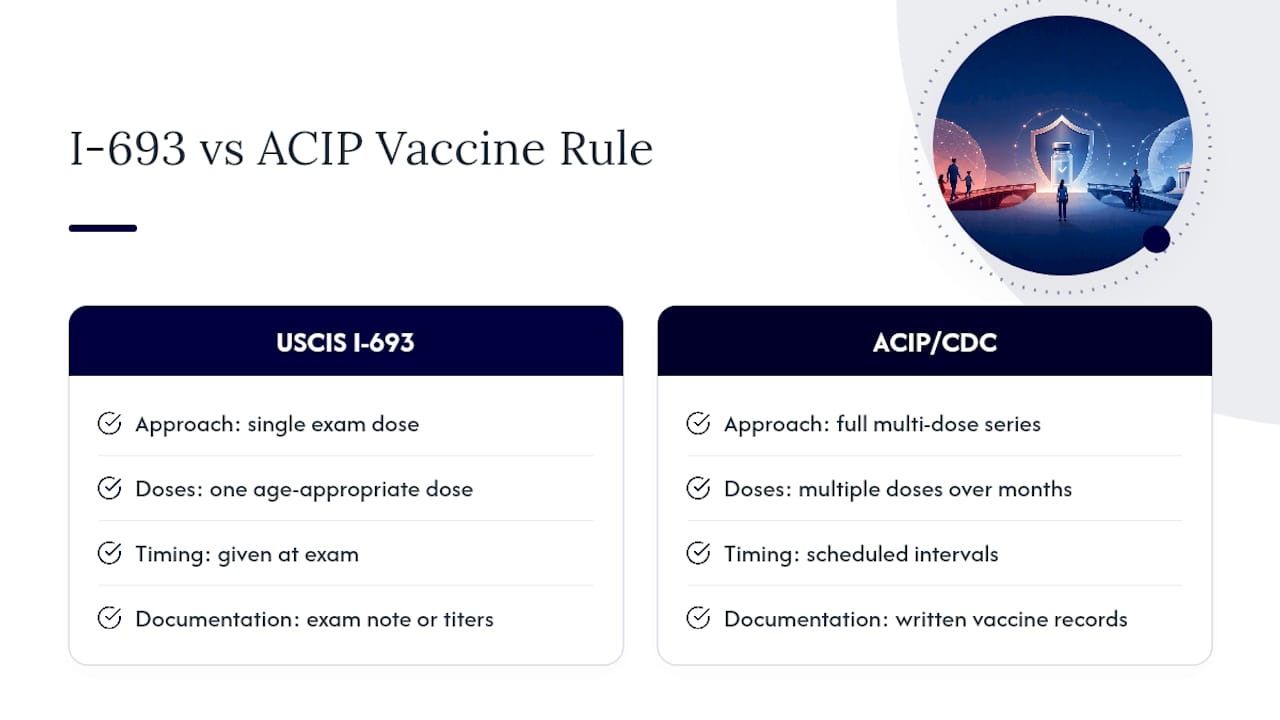
- A single age-appropriate dose at the exam often suffices for required vaccines, even if multiple doses are recommended by ACIP over time.
- Recent policy updates, like the removal of COVID-19 vaccination from requirements in March 2025, reflect CDC’s ongoing technical review process.
- Proper documentation includes certified translation of foreign records, valid vaccine records, and blood titers when available, to avoid delays.
- Exemptions require explicit documentation; blanket waivers are issued during shortages, while medical or religious objections need specific USCIS approval.
Table of Contents
- At-a-Glance Comparison: ACIP/CDC Schedule vs USCIS Required Vaccines
- How CDC Technical Instructions and Table 1 Determine USCIS Vaccine Requirements
- Vaccine-by-Vaccine Breakdown: What USCIS Actually Requires
- Exactly What Counts as Valid Documentation for Form I-693
- Timing Rules and Recent Policy Changes You Must Know
- How Blanket Waivers and Medical or Religious Exemptions Work
- How a Specialized I-693 Clinic Prevents Delays
- Practitioner Perspective: The One Mistake to Avoid
- Ready to Complete Your I-693 Without the Guesswork?
- Where to Verify These Requirements Yourself
- Sources
- FAQ
At-a-Glance Comparison: ACIP/CDC Schedule vs USCIS Required Vaccines
The Advisory Committee on Immunization Practices (ACIP) sets vaccination recommendations for the entire U.S. population, based on age, risk factors, and clinical judgment. USCIS pulls from that broader schedule but only requires the specific diseases and doses spelled out in Table 1 of the CDC Technical Instructions. That distinction trips up a lot of applicants who assume “vaccinated” means every ACIP-recommended shot for their age group.
Here is the practical difference between the two systems:
- ACIP schedule: Recommends dozens of vaccines and boosters across a lifetime, adjusted for age, pregnancy, occupation, and travel.
- USCIS requirement: Limits mandatory proof to a fixed list tied to immigration status adjustment, applied through Table 1’s age based grid.
- Selection criteria: CDC only adds a vaccine to the immigration list if it meets outbreak or disease-elimination criteria, not just general public health value.
- Age matters: A vaccine required for a 4-year-old applicant may not appear at all on the row for a 45-year-old applicant.
- One dose can satisfy USCIS: where ACIP calls for a multi-dose series over months or years, USCIS often accepts a single age-appropriate dose given at the exam.
That last point deserves emphasis because it is the single biggest source of confusion for applicants and, frankly, for some providers, too. The USCIS Vaccination Requirements page explicitly states that the required diseases include measles, mumps, rubella, polio, tetanus and diphtheria toxoids and pertussis, Haemophilus influenzae type B, hepatitis B, varicella, influenza during flu season, pneumococcal disease, rotavirus, hepatitis A, and meningococcal disease. That list looks long, but it is still shorter and more narrowly scoped than the full ACIP catalog, which also covers vaccines like shingles, HPV in older age brackets, and travel-specific immunizations that have no bearing on your I-693.
Don’t assume you need to complete an entire ACIP-recommended series before your appointment. If you are missing a shot on the required list, the civil surgeon can usually administer it at the visit and note the remaining series as something to finish later on the standard schedule. Chasing full ACIP compliance ahead of time wastes money and appointments without changing your eligibility for the I-693.
How CDC Technical Instructions and Table 1 Determine USCIS Vaccine Requirements
USCIS does not independently decide which vaccines to require. It defers entirely to CDC, which builds that list through a formal chain of review that starts with ACIP recommendations and ends with a document civil surgeons use every day: the Technical Instructions.
CDC adds a vaccine to the immigration-required list only when it meets two conditions together. First, the vaccine must be age-appropriate for the applicant. Second, the disease it prevents must meet outbreak potential or elimination-target criteria that CDC tracks for public health surveillance. That second filter is why the immigration list looks different from a routine pediatrician’s recommendation sheet. A vaccine can be broadly recommended by ACIP and still not appear on Table 1 if CDC does not classify the disease as a current outbreak or elimination priority for the immigration population.
Statistic Callout: Table 1, current since March 11, 2025, breaks required vaccines into specific age bands rather than a single blanket list, meaning two applicants of different ages can walk out of the same clinic with completely different vaccine requirements.
Once CDC finalizes Table 1, civil surgeons use it as their operating manual. Their job during your exam includes:
- Reviewing your existing vaccination records against the age row that applies to you.
- Ordering blood titers when written records are unavailable but immunity might already exist.
- Administering at least one age-appropriate dose on the spot when you are missing a required vaccine and no valid medical exemption applies.
- Documenting every result, whether by record, titer, or in-office dose, directly onto Form I-693.
Two recent examples show how this pipeline actually moves in practice. When COVID-19 vaccination stopped meeting CDC’s criteria for continued inclusion, USCIS updated its Policy Manual to drop the requirement entirely, effective March 11, 2025, after already halting related requests for evidence in January 2025. Separately, CDC issued a polio-related update effective May 1, 2024, clarifying how certain foreign oral polio doses are handled for adults lacking full documentation. Neither change came from USCIS policy staff acting alone. Both traced back to CDC’s own technical review process, which is exactly why checking the current Technical Instructions before your appointment matters more than trusting last year’s blog post, including this one a year from now.
Vaccine-by-Vaccine Breakdown: What USCIS Actually Requires
Here is where the CDC schedule vs USCIS requirements comparison gets concrete. Below is what applicants commonly ask about, vaccine by vaccine, based on Table 1 and the Technical Instructions.
MMR (measles, mumps, rubella): Required for nearly all age groups on Table 1. ACIP recommends two doses for children and often one for adults without prior immunity; USCIS frequently accepts documented immunity through titers if written vaccination records are missing.
Polio: Required across most childhood and many adult rows. A key documentation wrinkle: some foreign oral polio vaccine (OPV) doses given after certain dates may not count toward the U.S. schedule, so bring every available record rather than assuming an old OPV card is automatically valid.
Tdap/Td (tetanus, diphtheria, pertussis): Required at nearly every age. Adults who received Td as children but never Tdap as adults may need one Tdap dose at the exam, not a full booster series.
Hepatitis B: Required for most age groups. If you cannot document a prior series, a single dose at the visit combined with a plan to complete the remaining doses later usually satisfies the I-693.
Varicella: Required unless you can document either two doses, a prior diagnosis noted by a physician, or laboratory evidence of immunity. This is one of the more common gaps applicants have because varicella vaccination only became routine in the U.S. in the mid-1990s.
Influenza: Required only during flu season for immigration purposes, which follows CDC’s own seasonal guidance rather than a fixed calendar date. If your exam falls outside that window, the civil surgeon will not require it that visit.
Pneumococcal: Required primarily for younger children and specific adult age brackets, not universally across all ages.
Rotavirus: Required only for infants within the applicable age window on Table 1; it disappears from the requirement entirely once an applicant ages out of that row.
Hepatitis A: Required for most childhood age groups and increasingly relevant for certain adult categories depending on the current Table 1 version.
Meningococcal: Required mainly for specific adolescent age bands, reflecting ACIP’s own age-targeted approach to that vaccine.
The rule that cuts through most of the confusion here is simple: when you are not up to date, one age-appropriate dose given at your exam typically satisfies the I-693 requirement, even though ACIP’s own schedule for that same vaccine might call for a series spread across months. The civil surgeon documents the single dose and can advise you to finish the series on your own timeline afterward.
Pro Tip: Don’t schedule extra “catch-up” appointments at an urgent care clinic before your immigration exam trying to pre-complete every ACIP dose. Bring what you have; a civil surgeon experienced with Form I-693 can usually resolve gaps in the same visit.
Exactly What Counts as Valid Documentation for Form I-693
Getting your paperwork right the first time avoids the single most common cause of I-693 delays: incomplete or unreadable vaccination history. Follow these steps in order.
- Collect original or certified copies of vaccination records, with dates written as MM/DD/YYYY and the vaccine name or abbreviation clearly stated. Handwritten notes without a clinic name, provider signature, or official letterhead are frequently rejected.
- Get certified translations for any foreign-language records. Civil surgeons need to verify vaccine names, dates, and dosing intervals, and an informal translation from a family member usually will not hold up to scrutiny.
- Ask about titers if records are missing or incomplete. A blood titer showing existing immunity to measles, mumps, rubella, varicella, or hepatitis B can substitute for a paper record in many cases, and the Technical Instructions spell out how results must be documented.
- Understand the sealed envelope rule. Once your civil surgeon completes Form I-693, it must be sealed following USCIS procedure; opening it yourself can invalidate the exam and force you to redo the entire process.
- Submit Form I-693 alongside Form I-485 when your immigration category requires it, rather than mailing it separately or holding onto it, per the official I-693 instructions.
Applicants who show up with organized, translated, dated records almost always move through their exam faster than those who bring loose photocopies or rely on memory. A detailed I-693 checklist before your appointment solves most of this before it becomes a problem.
Timing Rules and Recent Policy Changes You Must Know
Vaccine requirements for immigration are not frozen in place. They shift as CDC updates its guidance, and missing a recent change can mean showing up prepared for a rule that no longer applies.
- COVID-19 removal: Effective March 11, 2025, COVID-19 vaccination is no longer required for adjustment of status, and USCIS had already stopped issuing related requests for evidence starting January 20, 2025.
- Polio documentation update: CDC issued clarifying guidance effective May 1, 2024, on how certain oral polio vaccine doses from other countries are counted toward the U.S. requirement.
- Influenza timing: Flu vaccination is only required during the CDC-defined flu season window, so an exam scheduled outside that period will not require it, while one scheduled inside it will.
Statistic Callout: Two recent federal policy changes, the January 2025 COVID-19 RFE pause and the May 2024 polio documentation update, show how frequently civil surgeons must recheck current Technical Instructions rather than relying on what was true a year earlier.
If you know a required vaccine is currently affected by a national shortage, or if your case falls right at the edge of a flu season boundary, talk to your civil surgeon about timing before locking in an appointment date. A few days’ difference can change what is required of you.
How Blanket Waivers and Medical or Religious Exemptions Work
Not every applicant has to receive every required vaccine, but the exceptions are narrower than most people assume.
- Blanket Waivers: These apply broadly, typically during a documented national shortage of a specific vaccine, and CDC, not the individual civil surgeon, determines when a Blanket Waiver is in effect.
- Medical contraindications: A civil surgeon can determine a vaccine is “not medically appropriate” for reasons such as pregnancy, allergy to a vaccine component, prior severe reaction, or another documented clinical condition, and must annotate that determination directly on Form I-693.
- Religious or moral objections: These require a separate, individual waiver application that USCIS itself adjudicates, not the civil surgeon, meaning simply telling your civil surgeon you object is not enough on its own.
- Vaccine shortages affecting your case specifically: Ask your civil surgeon whether a current Blanket Waiver applies to your situation before assuming you are out of compliance.
Waiver documentation has to be precise. A civil surgeon who skips the required Form I-693 annotation, or an applicant who assumes a religious objection is automatically valid without filing the separate USCIS waiver request, can end up with a rejected or delayed application through no fault of the underlying medical facts.
How a Specialized I-693 Clinic Prevents Delays
Since 2007, Immigrationmedicalexams has focused exclusively on immigration medical exams and Form I-693 completion. That singular focus, no primary care visits, no urgent care distractions, means every appointment is built around getting Table 1 requirements right, the first time.
That specialization shows up in a few concrete ways for applicants:
- Flat-package pricing designed to prevent the surprise add-on fees that come with clinics unfamiliar with immigration-specific billing.
- Standard I-693 processing in about 3 days, with a 2-day expedited option for applicants working against a filing deadline.
- On-site lab testing and vaccine administration, so a missing dose or needed titer does not require a second appointment somewhere else.
- 24/7 online scheduling, letting applicants book around work and family obligations instead of clinic hours alone.
Before your visit, bring every vaccination record you have, even partial or old ones, along with certified translations for anything not in English. If your history has gaps, the clinic can order titers or administer required doses on the spot rather than sending you elsewhere and adding weeks to your timeline. Applicants who come in after a previous exam ran into errors elsewhere, whether from incomplete documentation or a form completed incorrectly, are exactly the cases this kind of specialization exists to fix.
Practitioner Perspective: The One Mistake to Avoid
The most expensive mistake we see is over-vaccination. Applicants show up having paid for shots they never needed, chasing full ACIP compliance instead of the narrower Table 1 requirement. That costs money and time without moving the needle on eligibility. The bigger risk to your timeline isn’t a missing vaccine, it’s incomplete documentation nobody caught until the exam. Check the current Technical Instructions before your appointment, bring every record you have, and let the civil surgeon tell you what’s actually required for your age and category, not what a general checklist assumes.
— ImmigrationMedicalExams Medical Team
Ready to Complete Your I-693 Without the Guesswork?
Immigrationmedicalexams is the alternative to piecing together vaccine records across multiple providers before your immigration exam: one appointment covers the civil surgeon evaluation, on-site vaccinations, lab testing, and a properly sealed Form I-693, all under a flat-package price so you know the cost before you walk in.

Since 2007, our practice has handled immigration medical exams exclusively, no primary care or urgent care distractions pulling focus from getting your Table 1 requirements right. Standard processing runs about 3 days, with a 2-day expedited option when your filing deadline is close. We frequently see applicants who ran into delays, missing documentation, or errors from a previous exam done elsewhere, and our sealed I-693 process is built specifically to prevent that from happening again. Appointments are available for booking 24/7 online. If you want to see the full breakdown of what’s included, check our sealed Form I-693 service page and schedule your exam today.
Where to Verify These Requirements Yourself
Vaccine rules for immigration change without much public fanfare, so it pays to check primary sources directly before your exam rather than relying on any single article, including this one.
- CDC Technical Instructions for Civil Surgeons for the full procedural guidance civil surgeons follow.
- Table 1 PDF for the exact age-based vaccine grid.
- USCIS Vaccination Requirements page for the current required disease list.
- Form I-693 instructions for sealed-envelope and submission rules.
This article is general information, not a substitute for advice from a qualified doctor. Consult a qualified healthcare professional about your own circumstances before acting on anything here.
Sources
- Vaccination | Technical Instructions for Civil Surgeons
- Vaccination Requirements
- Form I-693, Instructions for Report of Immigration Medical Examination and Vaccination Record
- Table 1: Vaccine Requirements According to Applicant Age for Panel Physicians
FAQ
What Are the CDC Vaccine Requirements for USCIS Applicants?
CDC requires proof of vaccination against measles, mumps, rubella, polio, tetanus and diphtheria toxoids and pertussis, Hib, hepatitis B, varicella, influenza during flu season, pneumococcal disease, rotavirus, hepatitis A, and meningococcal disease, applied by age through Table 1.
What Are the USCIS Vaccine Requirements for 2026?
The required list follows the Table 1 framework, with COVID-19 removed from the requirement effective March 11, 2025; always confirm current Technical Instructions before your exam since CDC updates this list periodically.
What Vaccines Are Required for U.S. Immigration?
The required vaccines depend on your age at the time of the exam, but generally include MMR, polio, Tdap/Td, hepatitis B, varicella, seasonal influenza, pneumococcal, rotavirus, hepatitis A, and meningococcal, based on USCIS guidance.
Can I Get a Vaccination Exemption From USCIS?
Yes, through three paths: a CDC-issued Blanket Waiver during a documented shortage, a civil surgeon’s medical contraindication determination noted on Form I-693, or an individual religious or moral waiver that USCIS itself must adjudicate. A clinic like Immigrationmedicalexams can walk you through which category applies to your case.